A Case of Chiaroscuro and Everything Between Black and White
Una Chin-Riley enters a black-and-white mystery that reveals how much of life, loyalty, and identity exists somewhere between the obvious answers.

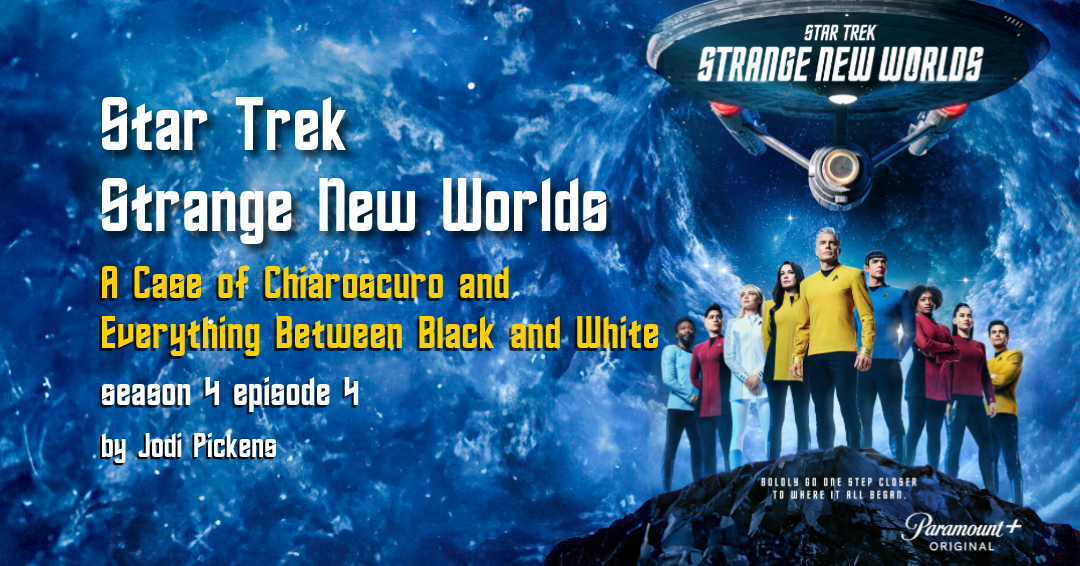
The moment Star Trek: Strange New Worlds decided it was going to spend most of an episode in black and white, put Una Chin-Riley in the middle of a film noir mystery, bring Kor into the proceedings, and make half the Enterprise crew start keeping secrets from one another, I was in. Completely in.
Give me the shadows and the suspicious people in hats. Give me the streets that look permanently damp and the cafés where everyone appears to know something they are absolutely not going to tell you. There is a wonderful Dixon Hill quality to “A Case of Chiaroscuro,” with a little Sky Captain and the World of Tomorrow retro-futurism wandering around the edges, and the entire thing looks gorgeous. I knew what kind of episode I thought I was watching, and then everybody started making decisions.
That is about the point where my nice little film noir adventure became considerably more complicated.
Chiaroscuro is an Italian art term meaning light and dark. Artists use the contrast between the two to create dimension and depth, allowing something that exists on a flat surface to appear three-dimensional. It is a perfect title for an episode that has so much fun removing color from the screen, although I don't think I appreciated how perfect it was until I realized the episode was doing essentially the same thing to its characters. It was adding shadows, and those shadows were showing me things I hadn't seen before.
That begins with Una.
I have wanted more Una-centered stories for a long time because knowing Number One is not quite the same thing as knowing Una Chin-Riley. We know the extraordinarily capable first officer who believes deeply in Starfleet, respects the chain of command, and can probably make an entire room sit slightly straighter just by walking into it. What we haven't seen nearly enough of is the woman becoming capable of sitting in the center chair herself, and “A Case of Chiaroscuro,” written by Skylar Ojeda and Dana Horgan and directed by Meera Menon, gives us an important part of that evolution.
The decisions Una makes on Mat’Aar 12 are not really about whether she knows Starfleet regulations. Of course she knows them. The more interesting question is what happens when knowing the rule is no longer enough, especially for a woman whose relationship with rules has always been deeply personal.
Una spent years hiding her Illyrian identity because the institution she loved had rules saying someone like her was not supposed to belong there. She responded by becoming an exceptional Starfleet officer, almost as if excellence itself might eventually make the contradiction disappear. It didn't, and everything she has lived through since has complicated the idea that following the rules and doing the right thing will always lead to the same place.
That history makes placing Una inside Navette‘s identity especially interesting. Both women survived by concealing something essential, although for very different reasons. As Una begins pulling apart Yvette's life, she discovers that almost everyone has a different version of who this woman was. Criminal, collaborator, resistance leader, protector, enemy. None of those descriptions is entirely imaginary, but none contains all of her either.
Una isn't simply solving a mystery anymore. She is being asked to decide what to do with what she discovers, and the answer is no longer sitting conveniently inside a Starfleet regulation. The younger Una might have found comfort in the order itself. This Una has already lived through what happens when rules and principles stop pointing in the same direction.
Oh, Number One. Look at you.
This is the character development I have been waiting for because Una is not becoming command material by learning more regulations, mastering more procedures, or figuring out how to give a more commanding order. She already knows how to do all of that. What she is beginning to understand is that there may come a day when the person sitting in the center chair has all the information available, understands exactly what Starfleet expects, and still has to decide that the right thing to do is something else.
Her choice on Mat’Aar 12 carries even more weight because Una remembers people who stood against injustice on her own world and remembers that her family chose not to stand beside them. Now she is somewhere else, watching people live under control and fear, and she has to decide whether completing her mission is enough. She decides it isn't, but the episode wisely refuses to put heroic music underneath that decision and hand Una a certificate confirming that she chose correctly. She changes the parameters of the mission, deceives people, interferes, and helps create an opening for people living under Klingon control. Then she has to live with the uncertainty of what she has done.
While Una is discovering how uncomfortable command can become when certainty disappears, Uhura is elsewhere demonstrating what happens when you pay very close attention to the person sitting across from you. Unfortunately for Kor, the person sitting across from him happens to be Nyota Uhura.
And yes, this is Kor. The Kor. The future Dahar Master who will travel through Star Trek history from The Original Series all the way to Deep Space Nine is sitting across from a younger Uhura believing he has control of the conversation, which immediately gave me one thought. Sir, you have made an error.
Kor thinks he knows what Uhura understands. He believes his language gives him privacy and that he can control which pieces of information are available to her. Uhura lets him believe that because her advantage has never been about being louder, stronger, or more intimidating. She listens, and there is something beautifully Uhura about that.
We talk about her gift for languages because it is the most obvious expression of her talent, but communication has always been larger than vocabulary. It is listening, noticing, recognizing patterns, and understanding what people reveal when they don't realize they are revealing anything at all. Watching Uhura quietly turn Kor's assumptions against him is one of those moments that made me think, there you are. I can see you becoming her.
That made what was happening with La'an elsewhere on the Enterprise even more interesting because she, too, is trying to understand what her observations are telling her. She becomes convinced something about the probe is wrong, while Spock does not believe the evidence supports the larger theory she is constructing. Technically, he is right. Unfortunately for everyone hoping this might simplify matters, La'an is right too.
Someone really has concealed information. Christine Chapel altered the probe records to protect the crew of the USS Yang, a medical ship that crossed illegally into Klingon territory to answer a distress call. La'an has correctly sensed the secret and completely misunderstood what the secret means, which feels like exactly the kind of complication she did not need while already trying to determine how much she can trust herself.
That is far more interesting to me than simply proving La'an right or wrong. Uhura succeeds because she understands what her observations mean. La'an recognizes that something is wrong but cannot yet reliably interpret what her instincts are telling her. Now the universe has essentially informed her that she should trust herself, except perhaps not the first story she builds around what she feels.
Well, that should clear everything up nicely.
Then Chapel makes the whole thing messier because she did not alter those records for money, ambition, revenge, or any other conveniently villainous reason. She did it to protect medical personnel who violated a Starfleet rule because someone needed help on the other side of a border. Suddenly I found myself looking back toward Matar 12 because this was starting to sound familiar.
Una is bending the rules because she believes people need help. Chapel has already bent the rules because she believed people needed help. La'an is trying to determine whether she can trust herself. Uhura has just succeeded because she trusted what she noticed rather than what Kor wanted her to believe. At some point during all of this, my fun little black-and-white detective story had quietly assembled an entire group of Starfleet officers making complicated decisions based on incomplete information.
Which brings us to M'Benga.
There are moments in an episode when the storytelling needs to stop moving quite so quickly and allow a character to sit with a question. Una asking M'Benga whether she did the right thing is one of them, and he is probably the person aboard the Enterprise most capable of understanding why the question does not have an easy answer.
M'Benga tells her about a time during the Klingon War when people stood between him and patients who needed his help. His responsibility as a physician was to save lives, and in order to reach those lives, he killed the people preventing him from getting there. His medical oath did not stop mattering because the circumstances became complicated. The circumstances forced him to decide what that oath required when two moral obligations collided.
He doesn't use the story to absolve Una or tell her that intentions make every choice acceptable. He gives her something more difficult. There are moments when no regulation, oath, philosophy, or friend can make the decision for you. The rules still matter. The lives in front of you still matter. The consequences still matter.
You still have to choose.
That is where Una's story on Mat’Aar 12 finally clicked into place for me. Star Trek characters have been bending regulations for the greater good since approximately five minutes after Starfleet wrote its first regulation, so Una breaking a rule is not particularly revolutionary. What matters is what she does with the power she has once she makes that choice.
Una does not decide the future of Mat’Aar 12. She does not appoint herself the hero of someone else's resistance or assume that wearing a Starfleet uniform gives her the moral authority to determine what happens next. She creates an opportunity and returns that opportunity to the people who actually have to live with whatever follows.
That feels much closer to the kind of command development I want for Una. Leadership is not always the dramatic center-chair moment where someone orders shields up while the music swells. Sometimes it is understanding the limits of your own authority, making a decision without knowing whether history will approve of it, and accepting responsibility because you were the person who chose.
Rebecca Romijn is especially good at allowing that uncertainty to remain visible without making Una seem indecisive. There is a difference between not knowing what to do and understanding the weight of what you have done, and this episode lets Una live inside that distinction. She leaves Matar 12 without the reassurance she wanted, but perhaps with something more useful for the commander she may eventually become.
By then, I had almost forgotten about the definition sitting inside the title.
Chiaroscuro. Light and dark used together to create depth.
The production team certainly understands that literally. Making a black-and-white episode is not simply a matter of removing the color after everything has been filmed. Lighting, makeup, costumes, set dressing, materials, contrast, and framing all have to communicate differently when color is no longer doing part of the work. Menon and the entire production team did not merely dress Strange New Worlds for film noir. For an hour, they rebuilt its visual language.
That alone is worth celebrating because one of the things I continue to love about this series is its willingness to look at another genre and apparently ask, “But what if we made it Star Trek?” Film noir is fun. Dixon Hill taught us that a long time ago. What makes this experiment work, though, is that the genre isn't simply sitting on top of the characters. It is helping us see them differently.
The more I thought about that, the more I realized the shadows hadn't made any of these people darker. They had made them more dimensional.
Una can be devoted to Starfleet and willing to disobey it. M'Benga can be a healer who knows he is capable of killing. La'an's instincts can be valuable and misleading at the same time. Chapel can believe deeply in Starfleet while deliberately concealing the actions of people who violated its rules. Uhura's strength can come not only from knowing the right words, but from understanding everything happening between them.
None of those contradictions weakens the characters. They make them feel more complete.
And that is particularly interesting in a prequel.
We already know pieces of where some of these people are going. We know the extraordinary officer Uhura becomes. We know Spock. We know Chapel. We know Kor. Even when we don't know every detail of a character's future, the nature of a prequel encourages us to look for the pieces clicking into place. There can be a temptation to treat character development as filling in blanks until the younger person eventually matches the one history remembers.
Strange New Worlds is doing something much more interesting.
The closer some of these characters get to becoming the people we know, the less simple they are becoming.
Uhura becoming Uhura does not mean drawing a straight line toward the communications officer on Kirk's bridge. It means discovering all of the experiences, instincts, doubts, relationships, and choices that eventually make that woman possible. Una's evolution does not require sanding away her contradictions until a perfect captain emerges. Those contradictions may be exactly what prepare her for command.
That excites me, and it also brings me to the increasingly suspicious relationship I am developing with the number of episodes remaining this season.
Because I am keeping track.
Una is changing. La'an is changing. Chapel is making choices that complicate what we thought we understood about her. Spock has been changing. Uhura is moving closer to the extraordinary officer we know she will become, while M'Benga seems determined to answer every question about himself by creating approximately three more.
I love all of this. I love that these singular genre episodes are not merely adventures that reset everyone before the next opening credits. At least, I hope they aren't, because the more dimension Strange New Worlds gives these characters, the more I need those dimensions to matter.
I don't need every question answered immediately, and I certainly don't want anyone rushed toward a future whose destination we already partially know. What I do want is for Una to carry Mat’Aar 12 with her. I want La'an to be changed by discovering that she could be right and wrong at exactly the same time. I want Chapel's decision to have weight, and I want Uhura to continue becoming Uhura one choice at a time. If you're going to show me the shadows, don't turn all the lights on next week and pretend they were never there.
When Una, M'Benga, and Uhura finally leave Matar 12 and color begins returning to the screen, the familiar world comes back with it. The uniforms look right again. The Enterprise becomes the Enterprise again. The people standing inside that world are the same people who were there before, but I wasn't looking at them quite the same way anymore.
Maybe that is the real trick of “A Case of Chiaroscuro.” The episode removes color so we will notice the shadows, then gives the color back after those shadows have shown us dimensions that were there all along. It isn't telling us that these people contain light or darkness. It is reminding us that knowing someone means becoming capable of seeing both at once, along with everything that exists between them.
Perhaps that is what I am enjoying most about watching these characters move toward futures we already know pieces of. We aren't simply watching them become the people history remembers. We are discovering how complicated they had to become to get there.
And Strange New Worlds, I am still keeping track.
Remember…
✨Be Kind. Do More Good. We Got This.
💫Until next time, lovelies, keep jibber jabbering about the stories and things that move you.