An Invitation
A childhood memory of the Enterprise begins a journey through Star Trek, representation, and the future that quietly invited me to imagine more for myself.

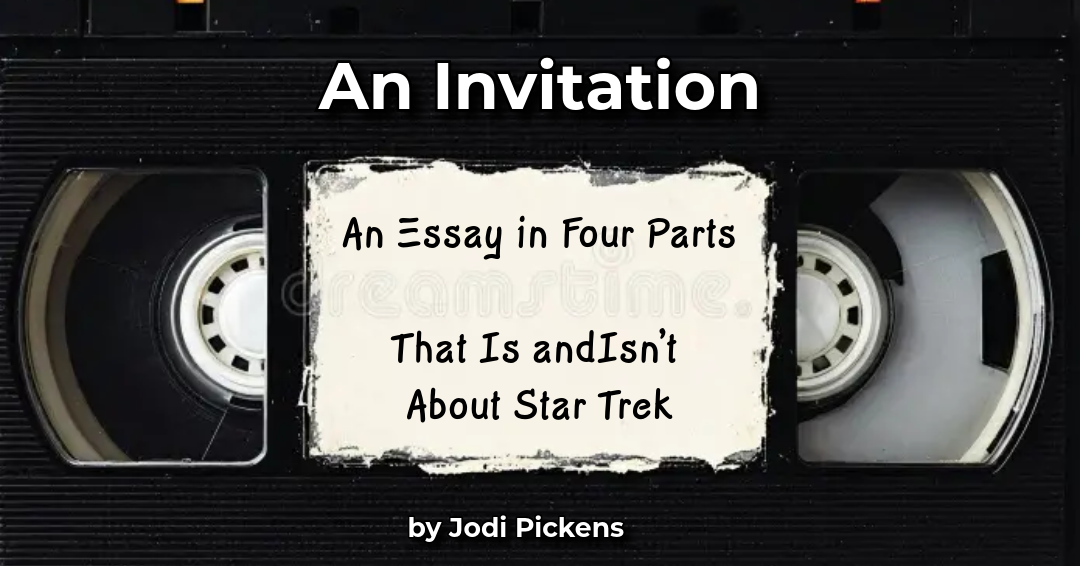
An Essay in Four Parts That Is and Isn’t About Star Trek
Part One
Every once in a while, someone asks me why I love Star Trek.
It’s a fair question. I’ve spent years talking about it on CloneStar Podcast, writing about it on social media, and finding any excuse I can to work it into a conversation. You would think I’d have an answer ready to go by now.
I usually don’t.
Not because I haven’t thought about it, but because every answer I come up with feels incomplete. I can talk about the characters I love, the episodes that have stayed with me, or the stories I find myself returning to again and again. I can tell you how much I admire Kathryn Janeway or why “Year of Hell” still gets to me after all these years. I can tell you how comforting it is to hear the opening notes of a Star Trek episode after a particularly difficult day.
All of that is true.
It just isn’t the whole truth.
The more I’ve thought about it, the more I’ve realized that Star Trek has never simply been a television show to me. It’s become one of those threads that has quietly woven itself through my life, and like most things that shape us over time, I didn’t notice it happening while it was happening.
That’s probably why I don’t remember the first episode I ever watched.
For years, I wished I did. It seemed like the kind of memory I should have, as though there ought to be one magical moment when everything changed. Surely there had to be one episode that started it all, one scene that made me fall in love with this universe.
Memory, though, has always worked differently for me.
When I look back, I don’t remember beginnings.
I remember feelings.
I remember the gentle hum of the Enterprise before I remember any particular story. Even now, it’s a sound that settles something in me. I remember watching Uhura at communications and never once thinking it was unusual that she was there. She belonged on that bridge as naturally as anyone else. I remember Spock standing nearby, saying more with a raised eyebrow than most people could say with a page of dialogue, and somehow making logic feel reassuring instead of distant.
Mostly, though, I remember wanting to be there.
Growing up in the Midwest, the bridge of the Enterprise felt like the most exciting place I could imagine. Every week there was another planet to explore, another mystery to solve, another culture to encounter. The crew never seemed interested in running away from people who were different from them. If anything, they leaned into those moments. They asked questions. They listened. Sometimes they got things wrong, but they kept trying to understand.
I don’t think I would have used the word curiosity back then.
I was just a kid who thought space was cool.
Looking back, though, I think that’s what first captured my imagination. It wasn’t the phasers or the transporters or the warp drive. It was the idea that the unknown wasn’t automatically something to fear. It might be challenging. It might even be dangerous. But it was still worth meeting.
I don’t know if I recognized it at the time, but that’s a remarkably hopeful way to look at the universe.
Years passed, as they have a habit of doing, and somewhere along the way childhood turned into adulthood. College became work, dreams slowly became responsibilities, and free time became something you appreciated because there never seemed to be quite enough of it.
By the time Star Trek Voyager premiered in January of 1995, my life looked very different from the one I had lived as a little girl sitting cross-legged in front of the television.
I was twenty-five years old and trying to build a career that, on paper, probably didn’t make a lot of sense. My music studio was just beginning to grow, one student at a time. I was working two part-time jobs because private teaching alone wasn’t enough to pay the bills yet, and whenever someone needed a saxophone player for a contract gig, I was usually the person saying yes.
Looking back now, I honestly have no idea where all that energy came from.
Oh, to be twenty-five again.
Watching television was different then, too. There wasn’t a streaming service patiently waiting for me whenever I happened to have a free hour. If you wanted to watch something and you weren’t going to be home, you trusted your VCR and hoped for the best.
I can still picture that tape.
I remember coming home and sliding it into the machine, wondering if the timer had worked, if I’d remembered to set everything correctly, and if the recording had started on time. There was always that brief moment of suspense before the picture appeared.
Then it did.
I don’t know that I’ve ever been so happy to discover that a VCR had done exactly what it was supposed to do.
I watched “Caretaker” over and over again.
If I found myself with a free evening, I was usually doing one of two things. I was either playing my saxophone or I was watching that tape again. I wasn’t taking notes. I wasn’t analyzing themes or thinking about where Voyager fit into the larger Star Trek universe.
I was simply enjoying spending time with those characters.
It’s funny, though. Looking back now, I realize there was one moment I kept returning to without ever understanding why.
Early in the episode, a Starfleet Admiral addresses Kathryn Janeway as “Captain.”
The scene lasts only a few seconds before the story moves on, and that’s exactly what has stayed with me all these years later.
No one explains why she’s in command.
No one comments on it.
No one treats it as remarkable.
She’s Captain Janeway.
Everyone accepts it.
The story continues.
At twenty-five, I couldn’t have told you why that scene affected me so deeply.
I only knew that it did.
It would take me years to understand that, if I wanted to explain why that one simple exchange had stayed with me for decades, I would first have to tell you about my mom.
PART TWO
If I want to explain why that one moment stayed with me, I have to tell you about my mom.
Actually, I have to tell you about both of my parents.
My sister and I grew up in a home where we were never told there were things we couldn’t do because we were girls. Our parents believed we could become whatever we were willing to work toward, and they lived that belief every single day. They celebrated our successes, picked us up after our disappointments, and somehow managed to make us believe that neither one should define us.
That kind of confidence is a remarkable gift to give a child.
My mom, though, had another gift she wanted to give us, and it came in the form of conversations.
Some of them happened around the dinner table. Some happened while we were cleaning the kitchen together. Others came out of nowhere because something on the news reminded her of a story she wanted us to hear. I don’t think she ever sat us down and announced, “Today we’re going to talk about women’s rights.” She simply folded those conversations into everyday life until they became part of the way we looked at the world.
She wanted us to know how hard women had fought for the rights we enjoyed. She wanted us to understand that those rights hadn’t simply appeared one day because people suddenly decided equality was a good idea. They had been earned by women who were willing to speak up, keep going, and refuse to accept that “that’s just the way things are” was a good enough answer.
Then she’d tell us stories from her own life.
She talked about doing the same job as men who earned more money than she did. She talked about promotions that somehow always seemed to find their way to someone else, even when she knew she had done the work. She talked about the quiet frustration of having to prove herself over and over again in ways her male colleagues never seemed to experience.
What I remember most isn’t the frustration in those stories.
It’s the determination.
My mom never told those stories to convince us the world was unfair.
She told them because she believed the world could become fairer.
There’s an important difference between those two ideas.
One asks you to accept things as they are.
The other asks you to help make them better.
I don’t think I appreciated that distinction when I was younger.
Like most kids, I assumed everyone’s parents talked about these things. I assumed everyone’s mom believed her daughters should understand both the opportunities they had and the obstacles they might face. It wasn’t until much later that I realized how intentional she had been.
She wasn’t teaching us to expect disappointment.
She was teaching us not to be surprised by it.
More importantly, she was teaching us not to let disappointment become the thing that decided who we would become.
Looking back now, I can see those conversations weaving themselves into my life in ways I never noticed at the time. They shaped how I approached my career. They shaped how I understood leadership. They shaped the expectations I had for myself long before I realized they had become part of me.
Which brings me back to Kathryn Janeway.
When I first watched “Caretaker,” I wasn’t thinking about any of those conversations with my mom. I was simply meeting a new Star Trek captain and wondering how this crew was ever going to find its way home.
It would take years before I understood why I kept coming back to that opening scene.
A Starfleet Admiral looked at Kathryn Janeway and called her “Captain.”
Then everyone went about their jobs.
The first time I watched it, I smiled and moved on.
The tenth time I watched it, I smiled and moved on.
The fiftieth time I watched it, I probably did the same thing.
It wasn’t until much later that I realized what I had been smiling at all along.
I wasn’t smiling because Star Trek had given us a woman in command.
I was smiling because no one in that century seemed to think there was anything unusual about it.
The story wasn’t asking me to admire Janeway because she had overcome being a woman.
It was asking me to admire her because she was a good captain.
Somehow, that simple choice by the writers said more than a speech ever could.
Without making a fuss about it, Star Trek quietly showed me the future my mom had been hoping my generation would inherit.
Not a perfect future.
Just a better one.
The older I get, the more I think that’s one of the reasons Janeway has remained my captain.
She isn’t inspiring because she always gets it right.
She’s inspiring because she keeps showing up.
She listens. She adapts. She changes her mind when she needs to. She carries the weight of command without pretending it doesn’t weigh anything at all.
Maybe that’s why, after all these years, I find myself watching Voyager differently than I did when I was twenty-five.
The stories haven’t changed.
I have.
PART THREE
When I first watched “Year of Hell,” I was captivated by everything happening to Voyager.
How could I not be?
The ship is battered almost from the moment the story begins, and things only get worse from there. Systems fail. Friends are lost. Every small victory seems to come at the cost of something else, and by the end you’re left wondering how much more this crew can possibly endure.
That’s what held my attention all those years ago.
Now, when I watch it, I find myself paying much less attention to the ship.
Instead, I watch Janeway.
I watch the way she carries herself when there aren’t any good options left. I watch her wrestle with decisions that don’t have perfect answers. I notice the quiet moments more than the dramatic ones because those are the moments that tell me who she is. They remind me that leadership isn’t about always knowing the right thing to do. Sometimes it’s about making the best decision you can with the information you have and accepting that it may still come with consequences.
I think age changes the way we watch stories.
At least it has for me.
When I was younger, I watched Star Trek for the adventure. I wanted to know what happened next. I wanted to see the mystery solved, the crisis resolved, and the crew safely on their way to the next star system.
Now I’m just as interested in what happens inside the people as what happens around them.
Maybe that’s one of the gifts that comes with getting older. You stop looking for perfect heroes and start appreciating honest ones.
Janeway has never felt perfect to me.
She’s stubborn.
She carries too much on her own.
Sometimes she waits too long to ask for help, and sometimes she makes decisions that leave me arguing with my television all these years later.
Oddly enough, I think that’s why I trust her.
She’s allowed to be complicated.
She’s allowed to get things wrong.
She’s allowed to learn.
Somewhere over the years, I realized that was true of nearly every Star Trek character who had stayed with me.
It wasn’t perfection that drew me back.
It was growth.
The people I loved most in Star Trek weren’t the ones who always had the answers. They were the ones who remained open enough to become different people than they had been when we first met them. Whether it was Picard learning to let people in, Kira learning that strength and vulnerability could exist together, Nog discovering who he wanted to become, or Janeway carrying the impossible responsibility of getting her crew home, they all had one thing in common.
They kept growing.
The older I get, the more I think that’s one of the most hopeful ideas Star Trek has ever offered us.
Not that people are born extraordinary.
That people can become extraordinary through the choices they make, the mistakes they’re willing to learn from, and the courage to keep moving forward when standing still would be easier.
I’ve found myself thinking about that more often than I used to.
Life has a way of humbling all of us. There are seasons when things come together beautifully, and there are seasons when nothing seems to go according to plan. I’ve lived through both. Most of us have.
There have also been moments when the world itself has felt heavier than usual. Moments when the headlines made it seem as though fear was winning, or kindness had become unfashionable, or the loudest voices had somehow become the only ones anyone could hear.
As a gay woman, I’ve lived through enough of those moments to know how easy it is to become discouraged. There were years when I wondered how long it would take before simply existing stopped feeling like a conversation other people believed they should be having about me instead of with me.
Those thoughts don’t disappear simply because you’ve lived through them once.
They have a way of showing up again when the world feels uncertain.
Maybe that’s why I still find myself returning to Star Trek.
Not because it helps me escape the world.
Because it reminds me not to give up on the people living in it.
That’s a very different thing.
PART FOUR
I’ve been thinking about my mom a lot while writing this.
Maybe that’s inevitable.
I started out trying to answer a question about Star Trek, and somehow I found myself back at our kitchen table, listening to her tell stories that, at the time, felt like they were simply about work. Looking back now, I realize they were never just about work. They were about dignity. They were about fairness. They were about believing the world could become something better than the one she had inherited.
I don’t think she would have described it that way.
She was simply raising her daughters.
That’s the thing about parents, though. They don’t always realize which lessons are going to stay with us. Sometimes the conversations we barely remember having become the ones we spend the rest of our lives quietly living.
The more I’ve thought about it, the more I’ve realized that my mom and Gene Roddenberry never really asked me to believe the same things.
They asked me to do the same thing.
Keep going.
Keep learning.
Don’t let the world convince you that the way things are today is the way they have to be tomorrow.
That doesn’t mean pretending everything is fine when it isn’t. My mom certainly never did that, and neither did Star Trek. The best Star Trek stories have never shied away from prejudice, grief, fear, or failure. They acknowledge all of it because those things are part of being human.
They just refuse to let those things have the final word.
I think that’s why Star Trek has never felt naïve to me.
It has always felt hopeful, and I’ve come to believe those are two very different things. Naivety ignores what’s broken. Hope looks directly at it, tells the truth about it, and then decides it’s still worth trying to make things better.
I’ve held onto that distinction more times than I can count.
I’ve held onto it as a musician trying to build a career one student at a time. I’ve held onto it through seasons when being a gay woman felt heavier than it should have. I’ve held onto it during moments when the world seemed determined to divide itself into smaller and smaller pieces, each one convinced it had nothing left to learn from the others.
Whenever I’ve started wondering if people are still capable of becoming better, my mind has had a funny way of wandering back to Star Trek.
Not because Star Trek has all the answers.
Because it keeps asking the questions I don’t want to stop asking.
What if curiosity really is stronger than fear?
What if listening changes more hearts than shouting?
What if the person who seems the most different from me has something to teach me?
What if the future isn’t something that simply happens to us?
What if we’re building it every day?
Those questions matter to me now in ways they never could have when I was a little girl sitting in front of the television, captivated by the hum of the Enterprise. Back then, I thought I wanted to live in the twenty-third century because it looked exciting.
Now I realize I wanted to live there because, even before I understood it, I recognized something familiar.
I recognized possibility.
Maybe that’s why the bridge of the Enterprise always felt so welcoming to me. It wasn’t just a place where people explored the galaxy. It was a place where people expected to keep learning from one another. They argued. They disagreed. They made mistakes. Sometimes they got things spectacularly wrong.
And then they tried again.
The older I get, the more I think that’s the future Gene Roddenberry was really inviting us to imagine.
Not a future where people stopped being people.
A future where we never stopped growing.
When I think back to twenty-five-year-old me, sitting on the floor in front of the television, hoping the VCR had recorded Caretaker correctly, I smile.
She thought she was meeting a new captain.
She had no idea she was also seeing the future her mom had hoped for.
She didn’t know that one quiet moment, when a Starfleet Admiral called Kathryn Janeway “Captain” and no one thought twice about it, would stay with her for decades. She couldn’t have imagined that years later she’d still be thinking about that scene, not because it was loud or dramatic, but because it was so wonderfully ordinary.
Maybe that’s been Star Trek’s greatest gift to me.
Not the adventures.
Not the ships.
Not even the characters, as much as I love them.
Its greatest gift has been the quiet belief that people can learn from yesterday without being trapped by it, that kindness is never wasted, and that the future is always asking something of us.
It has never asked me to believe people are perfect.
Only that we’re unfinished.
When someone asks me now why Star Trek has stayed with me for so many years, I think I finally have an answer.
It stayed because, somewhere between the hum of the Enterprise, a worn-out VHS tape of “Caretaker”, conversations with my mom around the kitchen table, and a captain who quietly showed me what the future could look like, Star Trek became more than a story I loved.
It became an invitation.
An invitation to stay curious.
An invitation to keep learning.
An invitation to believe that people really can become better than they were yesterday.
After all these years, I still accept that invitation.
Remember…
✨Be Kind. Do More Good. We Got This.
💫Until next time, lovelies, keep jibber jabbering about the stories and things that move you.