Hold the Hand

There’s a moment in “The Life of the Stars” when SAM asks the Doctor to hold her hand.
He hesitates.
And then he can’t.
A tear slips down her face. No dramatic swell. No big speech. Just a quiet, human fracture. I sat there longer than I expected after that scene ended. That was the moment this episode stopped being television and started being something personal.
Every once in a while, a story finds you at exactly the right time. A book. A play. An episode of Star Trek. It doesn’t just entertain you. It reveals something. This episode did that for me.
At its heart, this is a story about trauma and what it leaves behind.
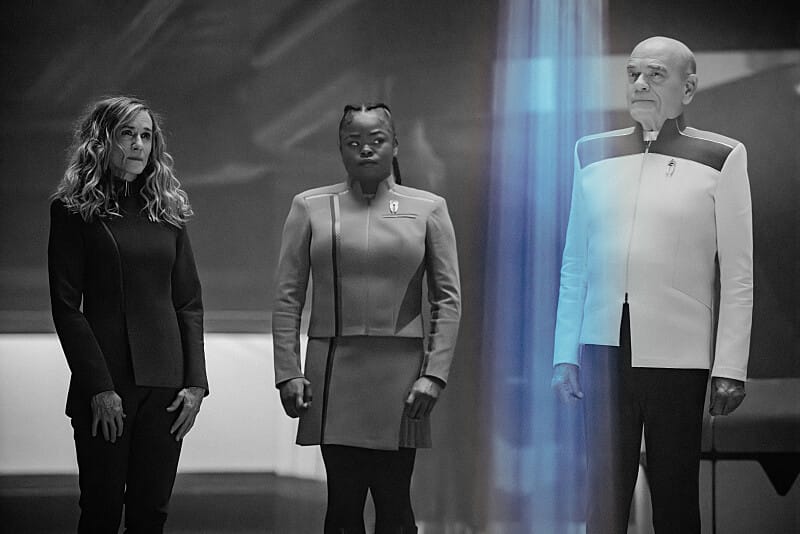
For centuries, the Doctor has carried the memory of the holographic daughter he created and lost. We remember that from Voyager. But here, we finally see how that loss calcified inside him. When he admits he saw that daughter in SAM and kept his distance because he could not survive loving and losing again, everything clicks into place.
It wasn’t detachment. It was self-preservation.
And if I’m honest, that stung. How often have I convinced myself I was being wise, when I was really just afraid? How many times have I stepped back to avoid the possibility of hurt and called it strength?
Robert Picardo plays this with extraordinary restraint. Watch the pause before he confesses the truth beside SAM’s body. Watch how he doesn’t raise his voice. Centuries of grief sit just beneath the surface. It would have been easy to make it theatrical. Instead, he lets it be small. And that makes it devastating.
Then there’s SAM.
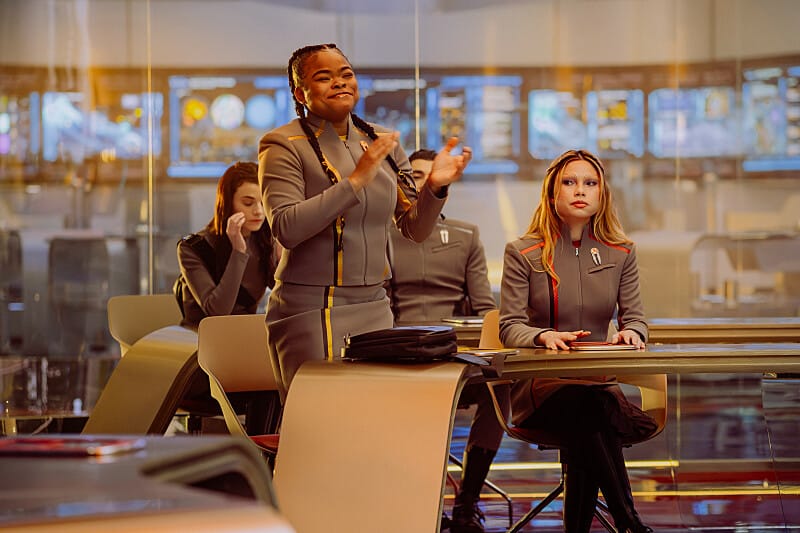
Kerrice Brooks continues to give SAM a luminous quality that makes this story work. There’s steadiness in her voice when she asks what love feels like. There’s childlike curiosity layered over something more fragile. When she collapses under the weight of unprocessed trauma from Miyazaki, it doesn’t feel like a technical glitch. It feels like grief overwhelming someone who was never taught how to survive it.
The Makers’ explanation is quietly brilliant, SAM evolved beyond their design, but she was never given the resilience that comes from childhood. No gradual exposure to fear. No practice with loss. She wasn’t broken because she was weak. She was broken because she was unprepared.
Meanwhile, the cadets at the Academy are unraveling in quieter ways. They’re brittle. Short-tempered. Avoiding the name of what they lost. Tarima’s brief, real laugh in the dorm room before it disappears again says everything. They are not who they were before Miyazaki.
And that’s where Our Town becomes more than a classroom assignment.
A play about ordinary life. Kitchen tables. Small conversations. The realization, too late, that the everyday was the whole point. In a franchise built on warp speed and cosmic stakes, this episode insists that the life of the village matters just as much as the life of the stars.
What makes this storytelling exceptional is that the episode doesn’t just reference Our Town. It mirrors it.
We are guided by narration. We watch a life interrupted. We confront death directly. And then we are given a return with new perspective. Even the pacing echoes the play’s meditation on time. The structure reinforces the theme – life is fleeting, ordinary, sacred.
That level of narrative alignment doesn’t happen by accident. It’s careful writing. Confident direction. A creative team willing to trust quiet moments over spectacle.
And then comes the boldest choice.
They let SAM die.
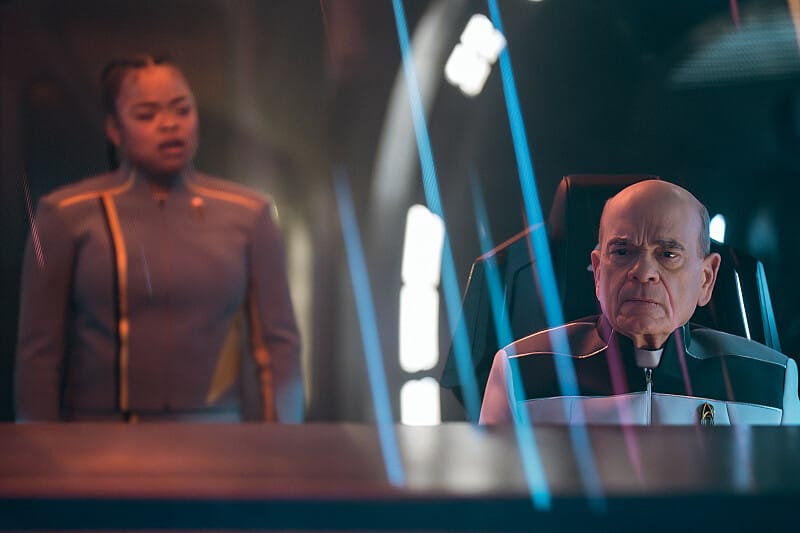
When the Makers declare her too damaged to repair and terminate her, it feels final. It hurts in that hollow, familiar Star Trek way. And in that silence, the Doctor finally breaks open. He admits the truth about his holographic daughter. About his fear. About why he kept his distance.
It is redemption. He stops observing life and chooses to live it, even knowing it could break him.
Ake’s proposal is radical and beautiful, give SAM a childhood. Let her grow up. Let her build resilience the slow way. Through scraped knees and awkward mistakes and love that offers no guarantees.
Seventeen years pass for them in what amounts to a blink for everyone else. That compression of time is pure Star Trek. Cosmic in scale, intimate in consequence. When SAM returns, she isn’t just repaired. She is grounded. Deepened. Someone who has lived long enough to understand what she almost lost.

The cadets change too. They stop pretending they are fine. They perform the play. They stand together. They admit they are different now.
And that’s the truth the episode leaves us with. Trauma changes us. We don’t get to go back. The question is whether we let that change harden us or deepen us.
We remember certain episodes of Voyager, The Next Generation, and Deep Space Nine because they leave us sitting quietly when the credits roll. Because they press on something human. “The Life of the Stars” belongs in that company.
It reminded me that time is vast and painfully finite all at once. That the small moments we rush through are the ones that shape us. That sometimes the bravest thing we can do is risk connection again.
So call the friend. Sit at the table a little longer. Say the thing you’ve been holding back.
And when someone reaches for your hand—
hold it.