Human Best Friend and the People Who Get Under Our Skin
A gloriously unpredictable Strange New Worlds episode explores the people who challenge us, irritate us, understand us, and become important almost without permission.

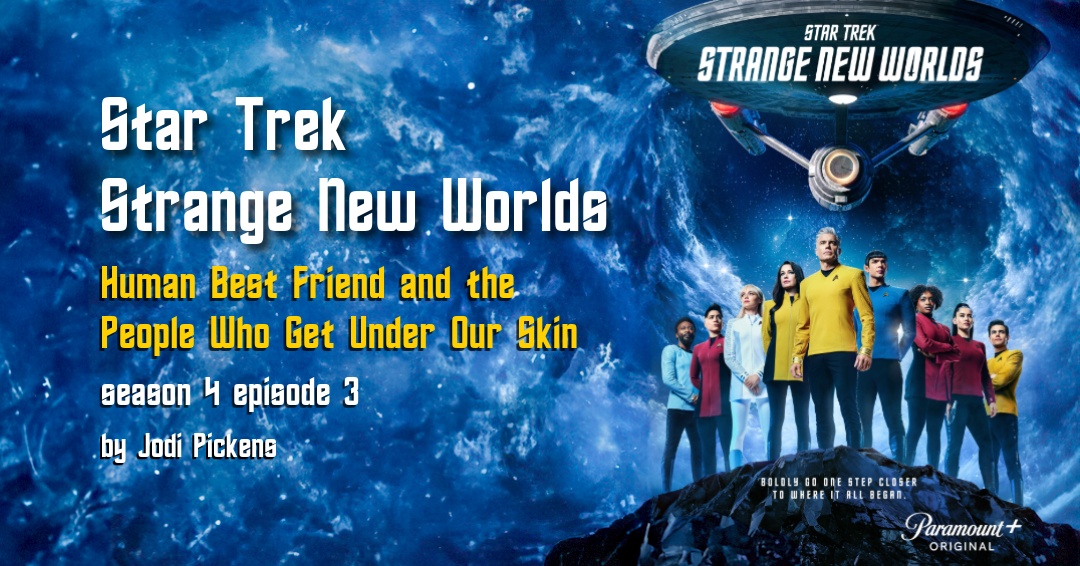
There are moments when I suspect the writers of Star Trek: Strange New Worlds sit around a table asking one another what they can possibly get away with.
Una Chin-Riley belting out a Klingon version of "Total Eclipse of the Heart" while M'Benga tends bar feels like someone decided to find out.
By the time "Human Best Friend" gives us Pike making some enthusiastic tattoo decisions, Chapel weaponizing bingo, La'an discovering that what she apparently needed from shore leave was the opportunity to form a small fighting force, and Spock attempting a mind meld with a plant, the answer appears to be quite a lot.
And somehow, most of it works.
Written by Kathryn Lyn and directed by Yana Gorskaya, "Human Best Friend" arrives immediately after the darkness of "The Griffin Incident" and seems determined to fling open every curtain and let some light back onto the Enterprise. After dinosaurs, temporal paradoxes, and psychological horror, Strange New Worlds decides what everyone really needs is a vacation. Not a relaxing vacation, obviously. This is Star Trek. A relaxing vacation would last approximately eleven minutes before someone discovered an ancient artifact under the hotel.
Instead, we get something that feels a little like The Hangover wandered through a transporter accident and emerged wearing a Starfleet uniform.
I was surprised by how much I enjoyed it, and not simply because it is funny. What caught my attention was how much character development Lyn manages to hide inside all that ridiculousness. The episode initially invites us to laugh at these people without their usual Starfleet filters, then quietly begins showing us things about them that are considerably more interesting than whatever happened during the parts of shore leave nobody can remember.
The most important of those discoveries belongs to Erica Ortegas and Montgomery Scott.
Their irritation with each other has been simmering for a while. Ortegas pushes the Enterprise. Scotty complains about what she does to his engines. Scotty creates warnings and safeguards. Ortegas treats those warnings like deeply personal insults delivered directly to her console.
Neither seems particularly interested in seeing the situation from the other's perspective, which feels wonderfully recognizable. Sometimes someone just gets under your skin. They say something and you immediately become 14 percent more irritated than the situation reasonably requires. They enter the room and somehow your internal monologue has already prepared a rebuttal. You tell yourself the problem is obvious because, from your perspective, it absolutely is.
Then every once in a while you discover that what you thought you were arguing about wasn't actually the argument at all.
That is where "Human Best Friend" finds its emotional center.
Ortegas once wanted to be an engineer.
Scotty once wanted to be a pilot.
Suddenly, everything between them looks different.
Lyn's smartest decision with their story may be waiting to tell us this. We've already watched them blame each other, begrudgingly cooperate, search for a shuttle they apparently hid from themselves, discover an access chip in the last place either expected, and get kidnapped because they apparently requested that too. Only after we've spent all that time laughing at their inability to get along does the episode give us the piece of information that reframes why they don't.
Each of them is exceptionally good at something the other once wanted desperately to do.
Ortegas isn't simply dealing with an engineer questioning how she flies. Somewhere underneath that irritation is the memory of a path she wanted and couldn't follow. Scotty isn't simply dealing with a pilot making his work harder. He's watching someone excel at something he once wanted to be able to do.
The people who irritate us most aren't always our opposites. Sometimes they're standing on the other side of the same disappointment.
That doesn't excuse the way Scotty and Ortegas have treated each other, but it gives their friction context. Gorskaya lets that understanding develop without sanding away the qualities that make the pairing entertaining. Melissa Navia and Martin Quinn remain prickly with each other even as their defenses start coming down, which is exactly why their growing affection feels believable.
Apparently what Scotty and Ortegas needed wasn't shore leave at all. They needed an escalating series of terrible decisions followed by kidnapping and mortal peril.
Starfleet Human Resources may want to avoid adopting this particular team-building model.
By the time Scotty and Ortegas genuinely believe they may not survive, all the annoyance that defined their relationship earlier has fallen away. Ortegas tells him she thinks they would have been friends, and Scotty simply tells her he thinks they already are.
The episode has done enough work by then that nothing more needs to be said.
Meanwhile, everyone else appears to be participating in a completely different experiment called, "What happens if we remove every adult supervision mechanism from the senior staff of the Enterprise?"
The results are informative.
Rebecca Romijn's Klingon power ballad may be the clearest example of why Gorskaya's approach to the comedy works. Nobody treats the ridiculousness as ridiculous. Romijn commits completely, and the direction allows Una to perform as though singing fifteen Klingon ballads in a row is an entirely reasonable way for a Starfleet first officer to spend shore leave. The scene is funny precisely because Una isn't trying to be.
M'Benga's transformation is quieter, but I think I love it even more. His hands are normally instruments of extraordinary precision. He uses them to heal people. They carry the terrible responsibility of knowing that a mistake can cost someone their life.
Here, he throws bottles.
Sometimes he catches them. Sometimes he doesn't seem particularly concerned when he doesn't.
For once, his hands don't have to save anyone.
That tiny detail tells us more about what relaxation might mean to Joseph M'Benga than a long conversation probably could.
The episode uses the same exaggeration elsewhere. Uhura relaxes so completely that everyone else's emergencies become disruptions to her vibe. Pike commits to body art with an enthusiasm that Future Pike may eventually have questions about. Chapel brings enough competitive aggression to bingo that I fear for the long-term emotional well-being of everyone else playing.
La'an, when freed from her usual restraints, somehow becomes even more La'an. She takes over a relaxation class and begins teaching people to fight, which is funny until you remember how often control has been connected to safety for her. Chapel's need to compete and La'an's instinct to command don't require lengthy psychological explanations here. I like them better as glimpses of familiar qualities with the volume turned all the way up.
Then there is Spock.
I would like to personally thank whoever decided Ethan Peck needed to spend part of an episode attempting to communicate telepathically with vegetation.
Watching intoxicated Spock is already funny because, to everyone around him, his altered state looks suspiciously similar to his normal state. Then he determines that a plant is actually a computer and approaches the problem with complete Vulcan sincerity.
"My mind to your leaves."
There are lines of Star Trek dialogue destined for immortality. I choose to believe this is now one of them.
But the episode saves its best Spock joke for much later.
James Kirk keeps appearing, and Spock quite reasonably, given everything else happening, concludes that Kirk is a manifestation of his altered state. That assumption gives him permission to become unusually open. He talks. He shares. He identifies Kirk as his "human best friend." He apparently says quite a few things he would never have said if he believed an actual James T. Kirk was sitting beside him.
For those of us who know where this friendship is headed, the whole thing carries decades of Star Trek history underneath the joke. We don't need the episode to tell us what Kirk and Spock will eventually mean to one another. We already know.
Which makes the reveal even better.
Kirk is real.
There are few social horrors greater than discovering the imaginary person you've been confessing everything to was not imaginary and has, in fact, heard the entire presentation.
Ethan Peck's dawning horror is magnificent, but Paul Wesley's response is what makes the scene more than a punch line. Kirk doesn't use Spock's embarrassment against him. He doesn't make fun of what he's learned. He promises that Spock's secrets are safe.
That's it.
And that's friendship.
It also gives us a nice counterpoint to Scotty and Ortegas. Their relationship changes because they finally understand something neither had shared. Spock and Kirk grow closer because Spock accidentally shares considerably more than he intended.
Friendship, apparently, is not particularly concerned with methodology.
That is where the title "Human Best Friend" becomes more interesting than I initially expected. It isn't simply a joke about Spock's extremely Vulcan way of categorizing Kirk. The episode keeps rearranging relationships because people learn things about one another they weren't necessarily meant to know.
Sometimes those discoveries are embarrassing. Sometimes they explain years of irritation. Sometimes they involve conversations with people you sincerely believed existed only inside your own head.
Being known can be inconvenient.
The episode itself isn't flawless. There are stretches where "Human Best Friend" seems reluctant to trust that its character story is enough. Once Scotty and Ortegas emerge as the emotional center, we probably don't need quite so many additional complications involving the shuttle, kidnappings, sabotage, an explosive device, and diplomatic negotiations all competing for attention.
It occasionally feels like the episode keeps adding ingredients to a meal that was already working.
The comedy gets cheesy at times too, but strangely, that bothers me less. There is a difference between a story accidentally becoming ridiculous and one understanding exactly how ridiculous it wants to be. "Human Best Friend" knows what kind of episode it is, and Gorskaya mostly keeps the energy moving fast enough that I was happy to follow wherever it wanted to go.
Even when where it wanted to go involved Spock communing with shrubbery.
What impresses me most is how much character work Lyn manages to accomplish while everyone appears to be having an absolutely terrible vacation. We learn something significant about Ortegas and Scotty, get another small but meaningful step in the Kirk and Spock relationship, and glimpse pieces of La'an, Chapel, M'Benga, Uhura, Una, and Pike that duty doesn't usually give them permission to show.
And despite all of their spectacularly questionable decisions, they still save one another.
The uniforms, rank, protocols, and training provide structure to everything these people do, but underneath all of that are relationships, instincts, trust, and years spent learning how to function beside one another. Apparently those things remain surprisingly effective even when your captain has half his face tattooed and is reading diplomatic remarks from his own body.
By the time the Enterprise is moving again, however, the moment I care about most is considerably smaller.
Ortegas goes to engineering.
Engineering is Scotty's space. It also represents something Ortegas once wanted for herself. Earlier in the episode, that history was part of what separated them. Now she walks into that space willingly, and Scotty lets her in.
He shows her what he's working on. She admits that maybe she could ease into things instead of always forcing them forward. He acknowledges his own part in their conflict. Neither gives up the qualities that make them good at what they do, and neither needs to.
Nothing about Scotty and Ortegas has magically changed. Erica is still going to push the Enterprise harder than Montgomery would prefer, and I suspect at least one of his alarms will continue to make her consider violence against Starfleet equipment.
But now the irritation has context, and the rivalry has empathy.
Somewhere between a disastrous shore leave, a missing shuttle, an accidental kidnapping, an explosive device, and the tragic loss of a truly spectacular shirt, two people who were convinced they couldn't stand each other discovered they might actually be friends.
Not bad for a vacation.
Although next time, perhaps they should just go camping.
Remember…
✨Be Kind. Do More Good. We Got This.
💫Until next time, lovelies, keep jibber jabbering about the stories and things that move you.