I Thought I Was Going to a Star Trek Convention
My first Star Trek Las Vegas convention became a story about fandom, friendship, belonging, and what it means to finally meet your Trek community.

The convention hadn’t even started yet.
We had arrived in Las Vegas the night before Star Trek Las Vegas officially began, gotten ourselves mostly settled into the hotel, and headed downstairs to preregister. This was my first Star Trek convention, so I was carrying the particular combination of excitement and absolutely no idea what I was doing that comes with being new to something everyone around you appears to have done seventeen times.
There were people who knew where to go. I was not one of those people.
Thankfully, my wife has a considerably better relationship with directions than I do. Left to my own devices, there is a reasonable chance I would still be wandering through that hotel trying to locate preregistration while insisting that I was pretty sure we’d already passed that slot machine.
But preregistration wasn’t really the thing I was thinking about.
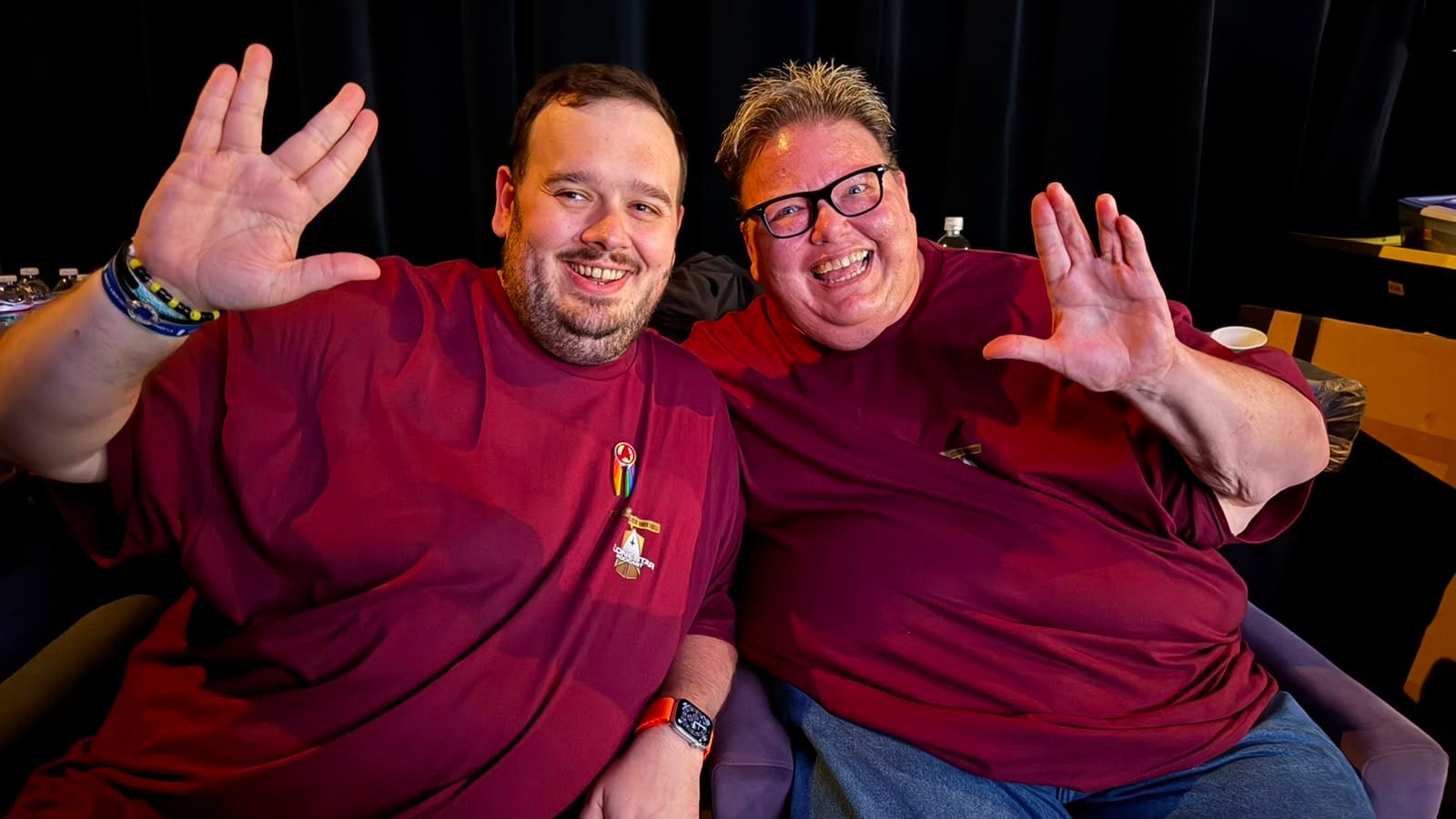
Mike was downstairs.
For the past three years, Mike Overton and I have co-hosted the CloneStar Podcast together. Our third co-host, Seo Hurley, lives in Ireland. Mike lives in the UK. I live in the United States, which means CloneStar has always required a certain amount of international cooperation just to figure out when everyone is awake.
We know each other well. We’ve recorded countless hours together. We’ve spent more hours on Zoom than any reasonable person should. We have group chats. We plan episodes, interview guests, talk about Star Trek, laugh, disagree, occasionally get distracted, and generally do all the things friends and collaborators do.
Mike and I had just never been in the same room.
That’s a strange sentence when you think about it. There are people in my life now whom I know because technology made geography considerably less important. Their faces are familiar. Their voices are familiar. I know how they’ll react to certain things. I know when they’re about to say something funny. I know the particular expressions that mean we’re about to wander completely away from whatever we were supposed to be discussing.
But until that night, every version of Mike I’d ever known had existed inside a screen.
And then there he was.
There wasn’t a cinematic moment. Nobody cued the music. The hotel lighting did not suddenly become more flattering. We didn’t run toward each other in slow motion while bewildered Star Trek fans parted dramatically around us.
We just saw each other and hugged.
It was both completely normal and completely surreal. Here was someone I already knew, except now he was three-dimensional. He existed below the shoulders. If the internet went down, he wasn’t going anywhere.
This felt like progress.
We talked. We laughed. We did what we always do, except nobody froze midsentence because their Wi-Fi had briefly reconsidered its commitment to the relationship. Somewhere in that first face-to-face conversation, before I’d attended a panel, walked through the vendor room, met a celebrity, taken a photograph, or done anything else I associated with going to a Star Trek convention, something about the whole trip had already shifted.
My Trek community had gotten closer, although I didn’t have those words for it yet. At that point, I was still mostly trying to comprehend the fact that I was finally at Star Trek Las Vegas.
The next morning, my wife and I headed into our first full day ready to experience as much as humanly possible. Everyone who had been to STLV before had offered roughly the same advice. You cannot do everything.
Naturally, we heard this and decided we would like to do everything.
This is apparently how first-time convention attendees approach reasonable expectations.
There were panels to see, people to meet, rooms to find, things to buy, photographs to take, autographs to consider, schedules to consult and then immediately reconsider. People were moving in every direction, some of whom clearly knew exactly where they were going.
Again, I was not one of those people.
Almost immediately, though, something else became apparent. Everywhere I looked, people were wearing their Trek. Some literally.
Uniforms from every era moved through the halls beside Vulcans, Klingons and characters I recognized instantly. Others required considerably more Trek knowledge than I possessed, which I respected deeply. Some people had clearly spent months creating what they were wearing. Others had found a Trek shirt and called the mission accomplished.
Nobody seemed particularly concerned about whether anyone else was doing fandom correctly.
You could cosplay every day. You could chase every autograph. You could spend hours in panels. You could wander the halls talking to people. You could wear a uniform so screen-accurate that someone at Paramount should probably check whether anything was missing from wardrobe, or you could simply show up because you loved Star Trek.
There was room for all of it.
At some point that first day, we found ourselves in the main theater. The Roddenberries were playing between panels, and they started playing the original Star Trek theme. Someone suggested we sing along.
Now, the original Star Trek theme does not offer the average audience an abundance of lyrics to work with.
This presented absolutely no obstacle.
A theater filled with Star Trek fans began singing the melody together in full voice. Dah dahh da-da dah daahhh. No hesitation. No self-consciousness. No collective moment where hundreds of grown adults stopped to consider whether this was perhaps a slightly ridiculous thing to be doing.
We committed.
As someone who has spent most of my life as a musician and music educator, I know what it means when a melody becomes so familiar that people don’t need words. Those opening notes carry decades of television, movies, characters, stories and memories with them.
But sitting there that day, I wasn’t thinking about any of that. I was listening to a room full of Trekkies enthusiastically singing da-das together like this was a perfectly normal thing to do.
These were definitely my people.
The funny thing about recognizing your people is that eventually some of them start recognizing you.
I was prepared to meet people I knew. I had been looking forward to it for months. There were podcasters and creators I’d talked with online, people I’d interviewed, people whose work I followed, and friends I’d somehow managed to make without ever actually standing next to them.
What I wasn’t prepared for were the people who walked up and knew me. There were people who followed the podcast and people who followed my personal social media. Apparently, some of them had been voluntarily consuming the nonsense I put on the internet and wanted to tell me they enjoyed it.
I wasn’t quite sure what to do with that information.
Creating things and sending them out into the world is wonderfully strange. You know people are watching or reading or listening because numbers on a screen tell you they are, but numbers are abstract. A view doesn’t have a face. A like doesn’t walk up to you in a convention hall and introduce itself.
People do.
Suddenly some of those numbers had names and voices and stories. Someone would mention a post, something I’d said, or something that had made them laugh, and I would find myself genuinely humbled that a thing I had tossed into the digital universe had landed somewhere in another person’s life.
At the same time, people who had occupied different corners of my Trek world were suddenly occupying the same hotel.
I got to hug the wonderful women of Sci-Fi Sistas. I met Jenny Johnson, whose art I absolutely adore. There were people like Jessie from Crusher Convo, the Trek Geeks, Sean from Trek United, and so many others whom I had known through conversations, collaborations, interviews, social media, or simply sharing this strange and wonderful fandom.
Then there were people I’d particularly hoped I would finally get to stand in front of and say hello to. Ellie Littlechild from TrekCulture was one of them. Bob and Mary from Trek Politics were others, along with Amy Imhoff and Spotted Giraffe, and Matthew and Heather from Trektivism.
There is a peculiar joy in finally meeting someone you’ve spent a long time knowing from afar. You already know their voice and their work. You’ve shared conversations and ideas. Then suddenly there is no screen involved. You get to occupy the same little patch of the universe for a while.
There was a lot of hugging, which is perhaps the least surprising development in the entire essay.
What struck me wasn’t that any of these relationships suddenly became real. They had always been real. I don’t believe friendship requires everyone to occupy the same ZIP code, country, or continent. CloneStar alone would collapse under that requirement.
But there is something different about looking around a room and seeing so many pieces of your life standing in it.
Meanwhile, my wife had apparently developed an entirely different convention objective.
Cosplayers.
I knew she would enjoy the convention. She’s a Star Trek fan. We’ve spent countless hours watching Trek together, and she’s been beside me through enough of my fandom adventures to understand that resistance is generally futile.
What I had not anticipated was the level of enthusiasm she would develop for people in costume.
She wanted pictures. Not necessarily with the actors. With the cosplayers.
Someone would walk past in an elaborate costume and suddenly we had a mission. I would be trying to determine where our next panel was while she was identifying the next person she absolutely needed to meet.
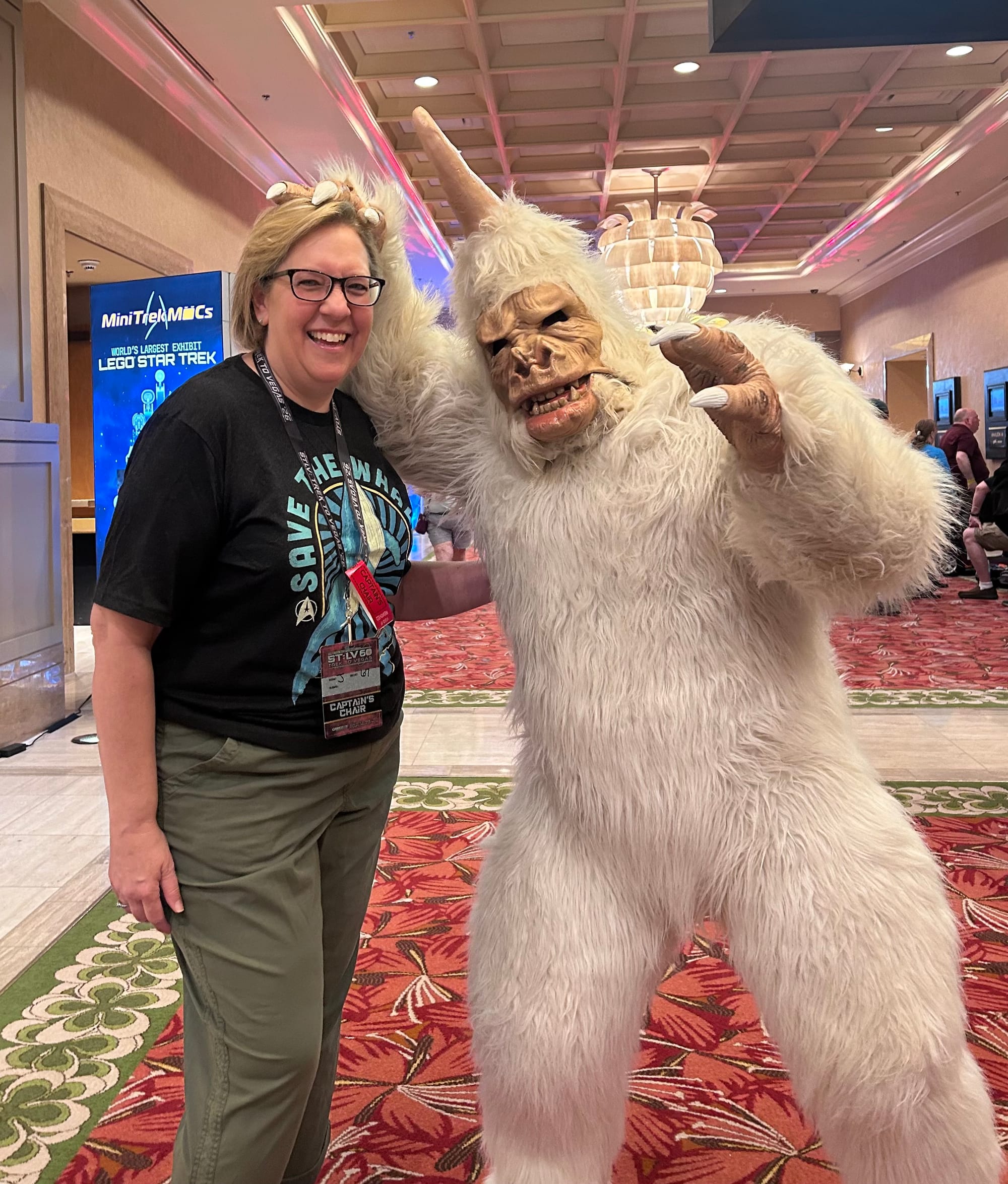
Then we encountered the Mugato.
For anyone unfamiliar with a Mugato, imagine a large, white, horned creature from the original Star Trek series that looks exactly like something you should avoid approaching in the wild.
My wife did not know what it was.
This did not matter. She needed a picture with it immediately.
There are moments in a marriage when you realize there is no question to ask and no discussion to have. Your job is simply to participate in whatever is happening.
So somewhere in my collection of memories from my first Star Trek convention is a photograph of my wife happily posing beside a Mugato she could not have identified five minutes earlier. It remains one of my favorite pictures from the entire trip.
She was having an absolute blast.
So was I.
Maybe that was another thing I hadn’t fully understood about being physically inside a fandom this large. Online, fandom can become fragmented very easily. We find our corners. We follow particular people. We talk about particular shows. We argue about episodes and characters and canon and occasionally things that probably do not require the level of emotional investment we have decided to give them.
Here, all those different versions of loving Star Trek were walking around together. Nobody needed to love it exactly the way I did.
We just needed a reason to be there, and Star Trek had given us one.
Of course, loving every minute of a convention and physically surviving every minute of a convention are not necessarily the same thing.
Everyone had warned us that there would be more to do than we could possibly fit into the days we had. We understood this intellectually. We nodded appropriately. We probably even agreed that we would pace ourselves.
Then we arrived and immediately tried to do everything.
Apparently, being two older gals with a full convention schedule does not automatically come with good judgment.
The days were long. There was always another panel, another person we wanted to see, another place we wanted to go. By the end of each day, we were exhausted, and every morning we got up and did it again because we were having too much fun to be sensible about any of it.
For me, though, moving through a convention that size came with another consideration.
For about the past eight years, mobility devices have been part of how I navigate the world. At home, I use a walker. When I’m somewhere that requires longer distances, I use a mobility scooter. It’s one of the lasting effects of the aggressive chemotherapy and radiation treatment I went through for breast cancer more than a decade ago.
I’ve had enough time with this reality that I know how to plan around it. I also know that not every space is equally easy to navigate. Crowds can be complicated, and a convention filled with thousands of excited Star Trek fans moving between panels, vendors, photo opportunities and everything else they’re trying to squeeze into a day can be especially complicated.
So I notice things. I notice whether there’s enough room to get through. I notice how people react when they realize a mobility scooter needs to pass. I notice whether accessing a space means finding another route or asking someone for help.
Most of all, I notice the difference between being technically accommodated and feeling as though I was expected to be there in the first place.
At STLV, the hotel and convention had systems in place to accommodate people using mobility devices. I appreciated that. But what stayed with me happened between all of us trying to navigate those spaces together.
Someone stepped aside in a crowded aisle. Someone noticed I needed to get through. People gave me space without making the moment into something larger than it needed to be. I saw that same consideration extended to other people using scooters, walkers and other mobility devices.
It was ordinary kindness. Nobody needed applause for moving six inches so another person could pass, and nobody made me feel as though my presence complicated theirs.
I was simply another Trek fan trying to get to the next thing.
And believe me, I was trying to get to the next thing. There was Trek happening. We had a schedule. Somewhere in that schedule was probably a room I did not know how to find.
But there is something about being included without having to continually negotiate your inclusion that stays with you. It isn’t necessarily the thing you tell someone first when they ask how the convention went. You tell them about the panels. You show them the pictures. You talk about the people you met and the Mugato your wife adopted for approximately thirty seconds.
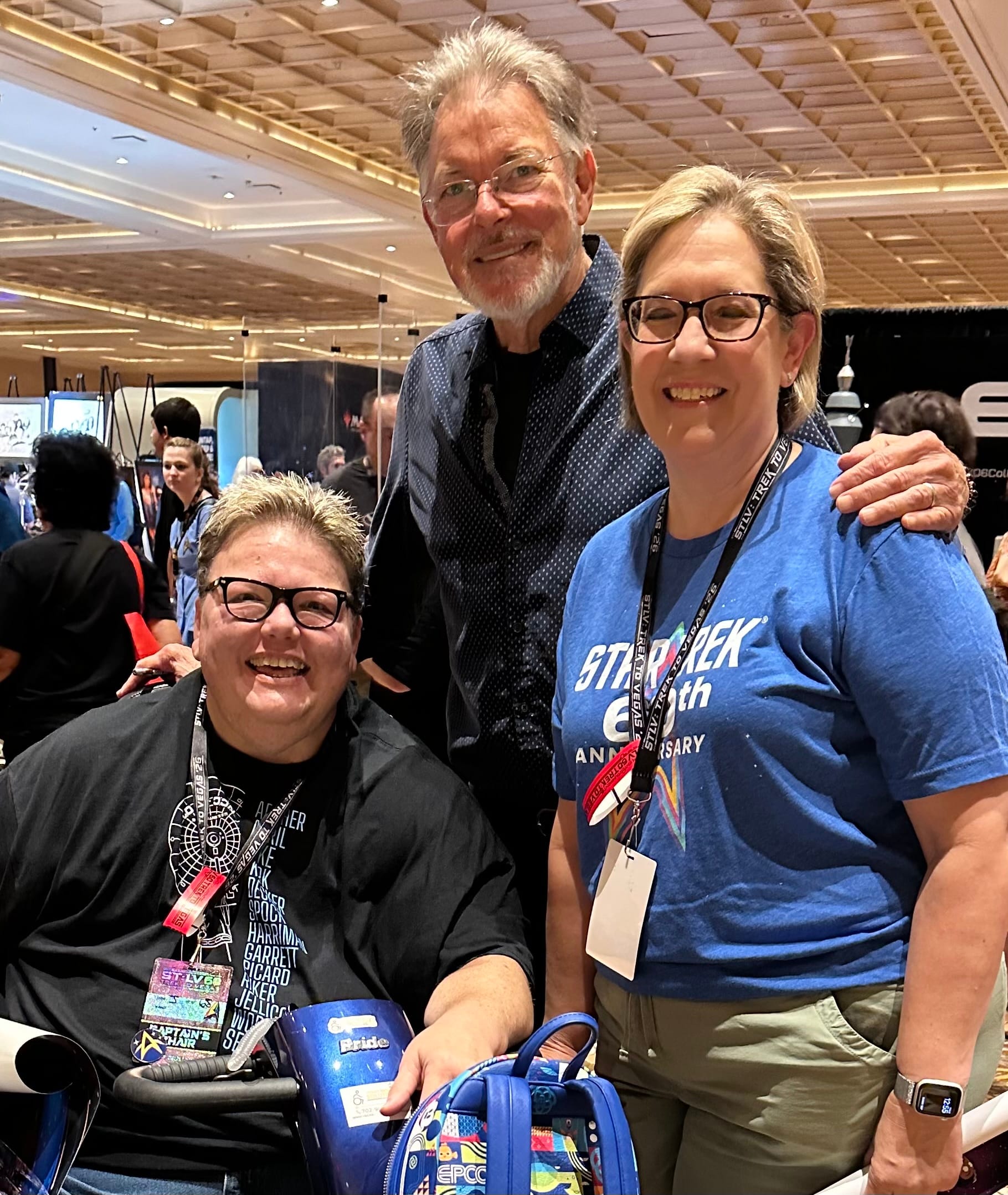
Underneath those memories, though, I carried something quieter.
I’ve spent years watching Star Trek imagine a future where our differences don’t determine whether we get to participate. Trek doesn’t always get that vision right. Neither do we. But the idea that we can keep working toward it has always mattered to me.
In Las Vegas, nobody needed to give a speech about it.
They simply lived it.
Later in the convention, my wife and I found ourselves back in the main theater for a Discovery panel with Wilson Cruz, Anthony Rapp, and Mary Chieffo.
This time, the room was packed.
We were there because we love Star Trek, obviously, but this particular panel came with another connection for us. My wife and I are Broadway people. We love musicals. We watch them. We listen to them. We sing along with them, whether anyone has requested our participation or not.
Rent has always been among the favorites.
So sitting in a room filled with Star Trek fans listening to Wilson Cruz and Anthony Rapp talk already felt like two different parts of our world had somehow wandered into the same place.
The panel was funny and warm and filled with the kinds of stories you hope to hear at a convention. They talked about their experiences, their memories, their work, and the people who had shared it with them. There is something wonderfully generous about watching creative people take experiences that belonged to them and offer pieces of those memories back to the people who loved what they created.
Then someone suggested we sing.
Apparently, this was becoming a theme.
Earlier in the convention, I’d sat in this same theater while hundreds of Star Trek fans enthusiastically sang the original series theme using nothing but da-das and absolute commitment.
Now we were being asked to sing Seasons of Love.
There are moments when you can feel a room decide something together. This room decided to sing.
Not the polite mumbling people sometimes do when they’re asked to participate in public. Not the tentative first few notes while everyone waits to see whether anyone else is actually going to do it.
Full voice.
The sound filled the theater. My wife was singing beside me. I was singing. All around us were people who had traveled from different places, lived different lives, loved different corners of this enormous franchise, and somehow we all knew what to do.
For most of my life, music has been one of the ways I’ve understood the world. I’ve been a musician since I was a kid. I’ve taught music. I’ve spent years inside rehearsals and performances and classrooms, watching what happens when individual voices become part of something larger.
I know what it feels like when a room sings together.
This felt different.
Maybe it was the unexpected collision of Broadway and Star Trek. Maybe it was because Rent already carries so many memories for my wife and me. Maybe it was because I’d spent the previous days watching people who had occupied different parts of my life suddenly occupy the same space.
Or maybe it was the song itself.
I found myself wondering if there could possibly be a song more appropriate for a room full of Star Trek fans than Seasons of Love.
I don’t think I need to answer that.
I remember looking toward the stage and seeing that the moment had reached Wilson Cruz too. There was emotion there, the kind that tells you the people on the stage aren’t standing outside the experience looking in. They’re part of it.
For those few minutes, the distances that had defined so much of my Trek community seemed very small.
Then the song ended, the panel continued, and eventually we went back into the convention where there were still people to meet, things to see, schedules to consult, and directions for me to misunderstand.
Life did not suddenly become a musical.
Disappointing, frankly.
Seasons of Love at STLV 2026
By the time STLV was over, I had accumulated the kinds of things you bring home from a convention. Photographs. Autographs. Things I’d bought. Things people had given me. A phone filled with pictures and videos.
But when I think about Las Vegas now, my mind doesn’t organize the experience by what I brought home.
I hear it.
A friend’s voice without Zoom between us. People introducing themselves. My wife laughing while posing beside a Mugato she didn’t know. Hundreds of Trekkies singing a theme song that didn’t need words, and later, a packed theater finding the words together.
I thought I was going to a Star Trek convention.
And I did. I saw the actors. I attended the panels. I took the photographs. I got the autographs. I spent long days trying to squeeze as much Trek as possible into every available minute and went back to our room exhausted and completely unwilling to complain about it.
All of that mattered.
But Star Trek turned out to be the thing that got us into the room.
The people were what made the room matter.
I’d known before Las Vegas that fandom could become friendship. I knew communities could exist across screens, time zones and oceans. I knew people didn’t have to occupy the same physical space for the relationships between them to be real.
STLV didn’t teach me any of that.
It gave all of it somewhere to stand.
The night before the convention began, I hugged a friend I’d known for three years and met for the first time. A few days later, I sat beside my wife in a theater full of Trekkies and sang with hundreds of people who somehow didn’t feel quite so much like strangers anymore.
I thought I was going to a Star Trek convention.
Turns out, I was going to meet my community.
Remember…
✨Be Kind. Do More Good. We Got This.
💫Until next time, lovelies, keep jibber jabbering about the stories and things that move you.