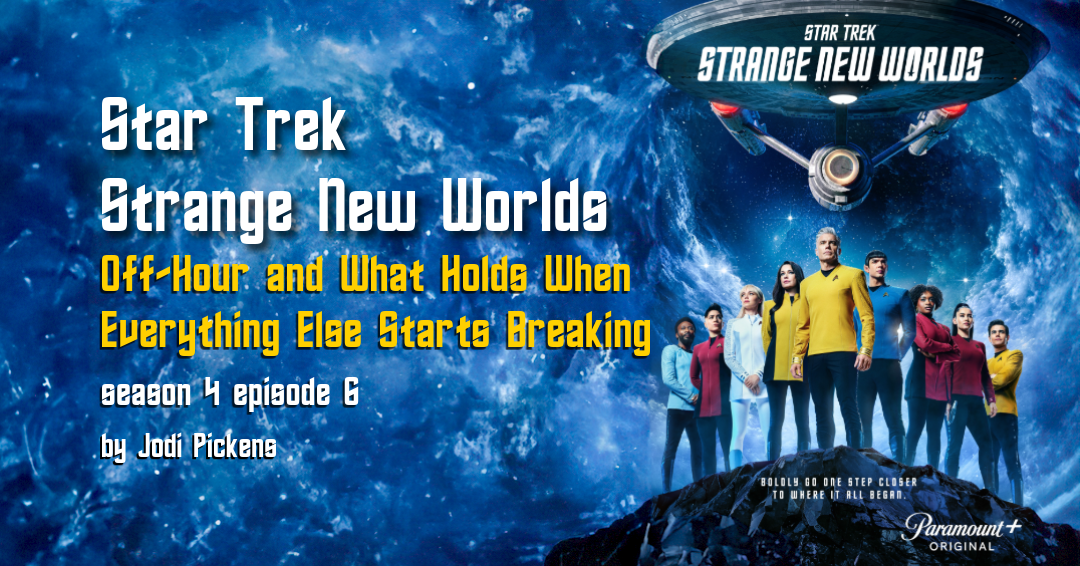
Off-Hour and What Holds When Everything Else Starts Breaking
A countdown clock threatens the Enterprise, but the heart of “Off-Hour” lies in the relationships, lessons, and trust already holding its crew together.

I have developed a completely reasonable distrust of countdown timers in Star Trek.
The moment somebody puts minutes and seconds on the screen, I know whatever everyone was planning to do that evening has officially been cancelled. There will be no quiet dinner. Nobody is finishing that book. Whatever personal conversation somebody has been avoiding will now have to happen while Red Alert flashes in the background and the computer calmly announces that everyone has considerably less time to live than they did thirty seconds ago.
“Off-Hour” gives us exactly that kind of clock, along with super strong neutrinos, a starship being pushed far beyond anything it was built to handle, and enough escalating catastrophe to make last week’s puppet crisis suddenly seem relaxing. We went from puppets to nearly losing the Enterprise, and I have to admire the range.
At first, I thought “Off-Hour” was going to be an episode about limits. The Enterprise has them. Its technology has them. Human and Vulcan bodies definitely have them. Even the relationships aboard the ship have places where trust, patience, history, and unresolved feelings start pushing against one another. Then the episode starts testing every single one of those limits at once.
But somewhere between Red Alert and that increasingly ominous countdown, I realized the limits were not actually what interested me most. It was what kept holding after everything else started breaking.
For an episode that spends so much time physically separating people, “Off-Hour” is remarkably interested in the things that connect them. Almost every solution depends on trust, history, or understanding that existed long before the crisis began. Some of those connections are still being built. Others have survived enormous change. A few have been forged through years of experience or shared tragedy. And right in the middle of all those separated people is Nyota Uhura, helping everyone reach one another.
Of course she is. She is the communications officer.
There has always been something more important about Uhura’s job than opening channels and relaying information. Communication is about making it possible for people separated by distance, language, circumstance, or sometimes the vacuum of space to reach one another. “Off-Hour” makes that beautifully literal. Uhura cannot physically put the Enterprise back together or be everywhere her crew needs her to be, but she can keep people from becoming completely isolated from one another. When everyone has been scattered into their own piece of the crisis, that becomes every bit as essential as engineering or medicine.
I particularly like that Cadet A’Sha, the Vulcan Uhura has been mentoring, becomes part of the effort to hold everything together. There was a time when Uhura was the one trying to find her place among officers with more experience than she had. Now A’Sha is learning from her while contributing to the solution herself, and that quietly tells us something about how far Uhura has come. She has become the person someone else can depend upon.
If Uhura shows us a connection still being built, Spock and La’an give us one that has already changed. After everything that has happened between them this season, when the situation demands trust, they do not need to stop and renegotiate what they mean to one another. Whatever existed between them is different now, but that does not mean everything they built disappeared with it.
What I like about that is the episode allows their relationship to have changed without pretending everything that existed between them disappeared along with it. Spock and La’an still know each other, and when circumstances force them to rely on that history, the trust is still there. Whatever happens between them from here, what they built together remains part of who they are to one another.
Pike and Una have another version of that shorthand, only theirs has been built across years. Their relationship has always been one of my favorites aboard the Enterprise because so much of it exists without explanation. There is history in the way they respond to each other and in how quickly they understand the weight behind the other person’s decisions. As Una continues becoming more confident in her own command abilities, I find myself paying more attention to those moments. We are not simply watching Pike’s Number One anymore. We are watching someone who has absorbed years of experience beside him and increasingly knows what to do with it.
Time has strengthened that relationship. For M’Benga and Chapel, history has done something more complicated.
I am not sure there is another relationship aboard this Enterprise quite like theirs, and I am not sure there needs to be a neat label for it. War, medicine, secrets, grief, survival. They have accumulated so much shared history that even before the crisis begins, M’Benga can challenge Chapel in a way few other people probably could. He is considering leaving the Enterprise, while Chapel has never been willing to make the ship her permanent home, and there is something almost quietly ironic about the two of them standing on opposite sides of that possibility.
Then “Off-Hour” very nearly takes the choice away from M’Benga altogether.
Chapel refusing to accept that he is gone carries the weight of everything these two have survived together, but I think what happens afterward matters just as much. Nearly losing M’Benga does not simply reinforce how important he is to her. It seems to force Chapel to look differently at the question he had already placed in front of her. What does she actually want? Where does she belong? And is she still keeping the Enterprise at arm’s length because she genuinely wants something elsewhere, or because committing to a place means admitting how much the people there matter to her?
That makes Chapel embracing her own path aboard the Enterprise feel earned rather than convenient. M’Benga does not tell her what that path should be. If anything, his own uncertainty about remaining aboard makes the choice more clearly hers. One of them may be beginning to imagine a life beyond this ship while the other is finally allowing herself to imagine a future on it.
And because we know where Star Trek eventually takes these characters, there is another layer underneath all of this. M’Benga considering leaving feels like one more small movement toward the Enterprise we will eventually know, but Strange New Worlds wisely makes that future matter because of what it means to the people living through the present. We know change is coming. They are only beginning to feel it.
Apparently, when conventional answers run out, we also have super strong neutrinos.
I have questions. Mostly where they are and why we do not have them. Can Starfleet keep some in a container? Is there a requisition form? Is this something you store next to the emergency medical kit? I realize I am probably misunderstanding several fundamental laws of physics here, but Star Trek has spent decades training me to accept a certain amount of technobabble as long as someone says it confidently while touching a console.
Super strong neutrinos it is.
Beneath the fictional particle physics, “Off-Hour” keeps bringing its characters to places where the obvious answer has stopped working and asks what they are willing to trust instead. Chapel refuses to believe the available answer is the only answer, and that feels like a natural bridge to another relationship where trust has slowly been changing the way someone sees himself.
Which brings me to Pelia and Scotty.
I have become increasingly fascinated by these two because their relationship keeps revealing things about Montgomery Scott before Montgomery Scott fully understands them himself. Scotty has spent a surprising amount of time on Strange New Worlds getting Scotty wrong.
He has underestimated himself. He has misunderstood why Pelia pushed him. We saw some of that insecurity with Ortegas in “Human Best Friend,” and “Level-Five Transporter Accident” gave us the wonderful realization that Pelia did not push Scotty because she thought he was the weaker student. She pushed him because she knew he could be better.
“Off-Hour” takes that relationship somewhere even more interesting. Pelia has an understanding of the Enterprise that is not entirely mechanical. She listens to the ship. She trusts what she knows about it in a way that reaches beyond specifications, calculations, and what the engineering manual says should be possible.
And Scotty believes her.
Somewhere in that small act of trust, I could suddenly see the engineer who will someday talk about the Enterprise the way other people talk about someone they love. We already know that Scotty. He will know exactly how far his engines can be pushed, usually while insisting to a captain that they absolutely cannot be pushed that far. He will hear things in the Enterprise that other people do not, and he will treat the ship as something more than an accumulation of circuits, conduits, engines, and bulkheads.
Here, we get to watch a little piece of that relationship being built. Pelia listens to the Enterprise, and Scotty listens to Pelia. Honestly, if anyone was going to teach Montgomery Scott that a starship has opinions, it was always going to be Pelia.
What makes that even more meaningful is Pelia’s trust in him. She has lived long enough to accumulate more experience than almost anyone around her, and she is not exactly known for handing out uncomplicated praise. Yet she sees something in Scotty worth pushing, irritating, challenging, and eventually trusting with the thing she may understand better than anyone else aboard. We already knew Scotty was special. Watching Pelia know it before he does makes him more interesting.
Through them, the episode quietly widens its idea. The crew is connected to one another, but they are also connected to the Enterprise and to a universe that has a fairly consistent habit of responding to Starfleet curiosity with some variation of, “You probably should not have touched that.”
Exploration sounds wonderfully noble until the thing you are exploring starts tearing apart your starship.
That contradiction has always been part of Star Trek. You do not discover strange new worlds by staying somewhere safe. Sometimes curiosity gives you something astonishing. Sometimes it gives you super strong neutrinos and a countdown clock. The Enterprise may be built to enter the unknown, but that does not mean everything waiting there is something she was built to survive. These people know exploration can hurt them, and they keep exploring anyway.
A lot of credit belongs to Bill Wolkoff and Dan Liu for making all of that separation feel connected rather than fragmented. One person’s information becomes another person’s possibility, and the pressure keeps escalating without reducing fifty-six minutes to people shouting over Red Alert. There is still room inside the emergency for the character moments to matter, which means we care about the danger because we care about the people inside it.
After an entire episode about pushing limits, though, I do have one significant complaint. The Enterprise exceeds known warp speeds and nobody turns into a salamander.
Honestly, what are we even doing here?
Voyager established precedent.
I realize there are probably complicated scientific reasons involving slipstreams, wormholes, neutrinos, and several words I would have to pretend to understand, but if Star Trek starts pushing beyond known warp limits, longtime fans have expectations.
I am just saying.
Beyond my disappointment over the complete lack of salamanders, “Off-Hour” makes sure we never forget how dangerous this situation actually is. That feels especially striking one week after watching indestructible puppet versions of this same crew lose limbs, get restuffed, and survive being yeeted into space. This time, the damage hurts. The danger has weight, and suddenly all those relationships we have been watching develop matter even more because these people really can lose one another.
That contrast also reminded me how much tonal territory Strange New Worlds is willing to cover. One week I am contemplating Spock’s subconscious while wondering why Pelia is barefoot. The next I am watching a countdown clock and mentally informing everyone that they should have stayed home. Yet both episodes remain interested in these characters, and that consistency matters more to me than consistency of genre.
“Off-Hour” never has to stop those character journeys to tell its disaster story. It simply puts the disaster directly in their path and lets us see what all those relationships, lessons, disagreements, losses, and experiences have built. No single character gets to be the hero who saves the Enterprise while everyone else waits for instructions. Spock cannot logic them home alone. Pike cannot captain hard enough to solve every problem. Scotty cannot engineer his way around every obstacle, and medicine cannot fix what it cannot reach. The solution exists somewhere between all of them, in the things they know individually and the ways they have learned to trust one another.
Which brings me back to that clock.
Maybe that is why the countdown bothered me so much. A clock like that reduces everything to what is disappearing: time, power, options, hope. Every second tells you there is less than there was before, while “Off-Hour” keeps drawing our attention toward something the clock cannot measure. There is the history between Chapel and M’Benga, the trust between Pike and Una, whatever still exists between Spock and La’an after everything that has changed, Uhura making sure nobody disappears simply because they cannot reach one another, and Pelia teaching Scotty to listen to a ship he will someday know almost as well as himself.
The Enterprise survives because those connections existed before anyone started counting down, and maybe that is the part of exploration we talk about less often. We imagine boldly going as movement outward, toward new worlds and new possibilities, but nobody goes very far alone. Exploration depends just as much on what we carry with us, the people we trust, the things they have taught us, and the connections strong enough to hold when everything else starts breaking.
That is what stayed with me after “Off-Hour.” Well, that and the super strong neutrinos, because I still want to know where we can get those.
And I still don’t trust the timer.
Remember…
✨Be Kind. Do More Good. We Got This.
💫Until next time, lovelies, keep jibber jabbering about the stories and things that move you.