The Choice to Still Believe in the Future

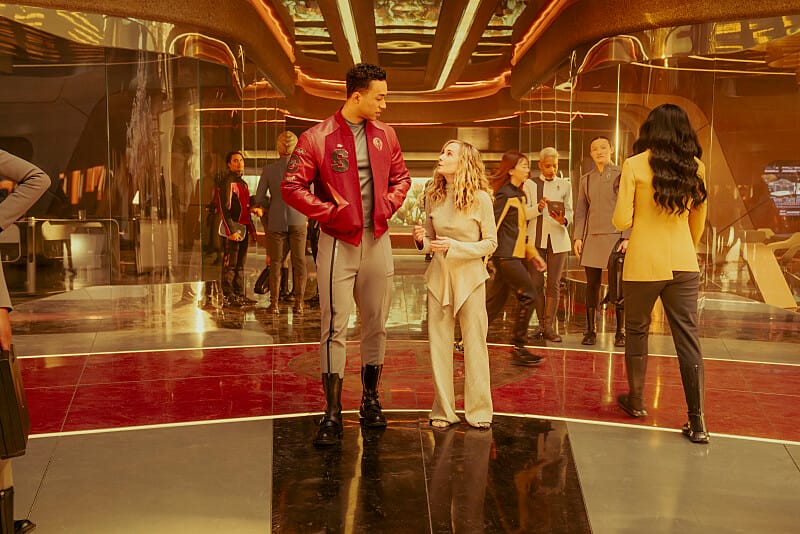
What stayed with me most about “Rubincon” was Caleb telling his mother that Starfleet is his home, but so is she.
That line just landed.

It was not a surprise exactly. This whole season has been pushing Caleb toward that realization. But hearing him say it out loud made the whole episode click for me in a different way.
Because that is the real conflict at the heart of “Rubincon.”
Not just whether Braka can be stopped.
Not just whether the Federation can survive this moment.
But whether someone can still choose a future inside an institution that has already hurt them.
That is a hard question. Personally, politically, emotionally. And it is what makes this finale stronger than a straightforward good-guys-versus-bad-guy ending.
Yes, all the big finale pieces are here. The Federation is cornered. The Athena is stuck in an impossible situation. The stakes are massive. Braka is out there trying to force the whole quadrant to see the Federation through his lens.
All of that works.
All of that brings urgency.
But what gives “Rubincon” its weight is that underneath all of it is a story about trust, and what it costs to ask for trust after it has already been broken.
That is why Anisha matters so much here.
And I am really glad the episode knew that too.
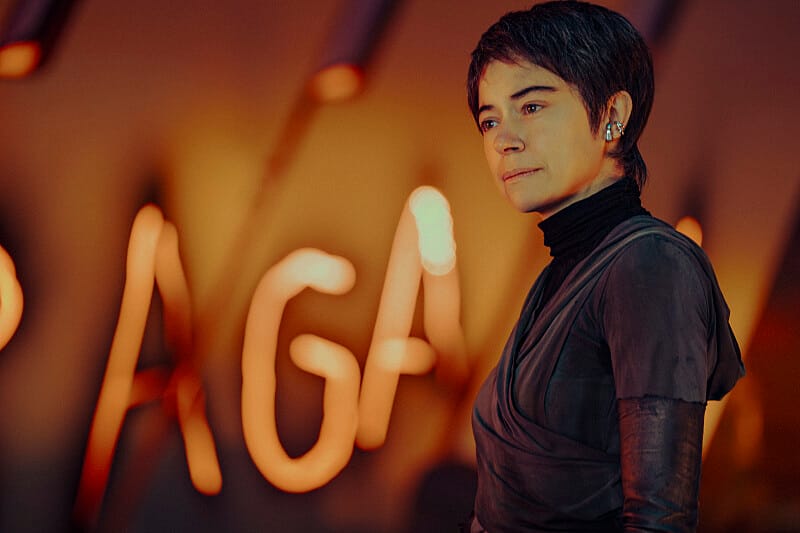
It would have been easy for a finale like this to treat Anisha’s pain as backstory. As context. As one more emotional note in a much bigger plot machine. But “Rubincon” keeps bringing us back to the fact that before the minefield, before Braka’s spectacle, before any tactical crisis, there is a mother who lost her son to the Federation.
The episode never lets us look away from that.
So when she reacts with anger, when she cannot just slip neatly into cooperation, when being in the same space as Ake still carries all that history and hurt, it works because it should work.
It should still hurt.
The episode does not ask her to be tidy, and I appreciated that.
Because pain like that is not tidy.
That is also what makes the dynamic between Anisha and Ake so important. The episode does not make this easy for either of them. It does not let Anisha become unreasonable just to create conflict, and it does not let Ake become a clean symbol of Starfleet goodness either.
Ake has to stand in the middle of all of this and still defend the Federation without pretending it has done no harm.
That is not a simple position.
It should not be.
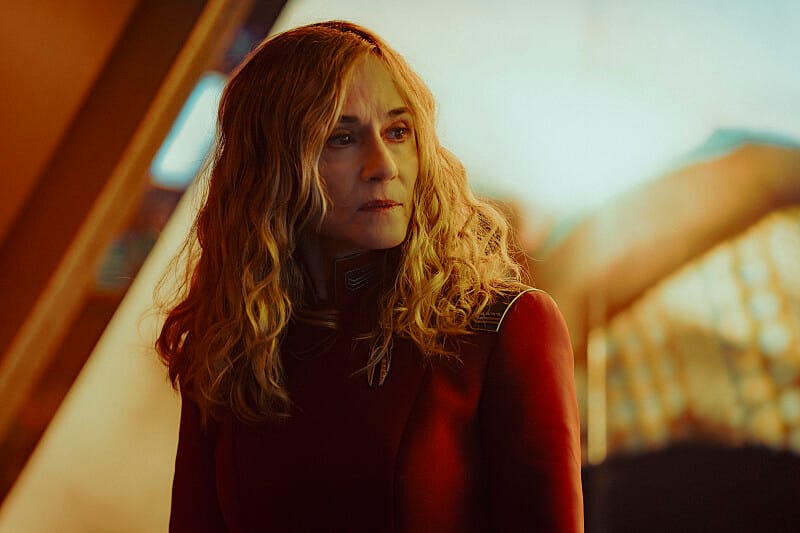
What Holly Hunter does here, and what the writing gives her room to do, is make Ake feel like someone carrying the weight of belief. Not blind belief. Not institutional loyalty for its own sake. Belief in what the Federation is supposed to be, while also knowing very clearly what it has failed to be for people like Anisha and Caleb.
That is much more compelling to me than if the episode had tried to clean any of that up.
Because “Rubincon” is not really interested in innocence.
It is interested in whether ideals still matter once they have been imperfectly lived.
That is where Braka becomes more than just the season villain.
Braka is not just trying to win. He is trying to control the meaning of what happened. He takes the Federation’s failures, turns real pain into public argument, and packages suffering into a narrative that makes every ideal sound hollow.
And that is exactly why it works.
The episode understands how propaganda actually works.
It rarely begins with something completely invented. It begins with something real, something people recognize, something people have lived. Then it gets sharpened, narrowed, stripped of complexity, and used to push people toward fear and division.
That felt very current to me.
Braka is dangerous not because he has the fullest understanding of the truth.
He is dangerous because he knows how to make his version of the truth feel whole.
He knows how to make grievance feel like clarity.
He knows how to take pain and turn it into momentum.
And that is why he works as more than just a villain.
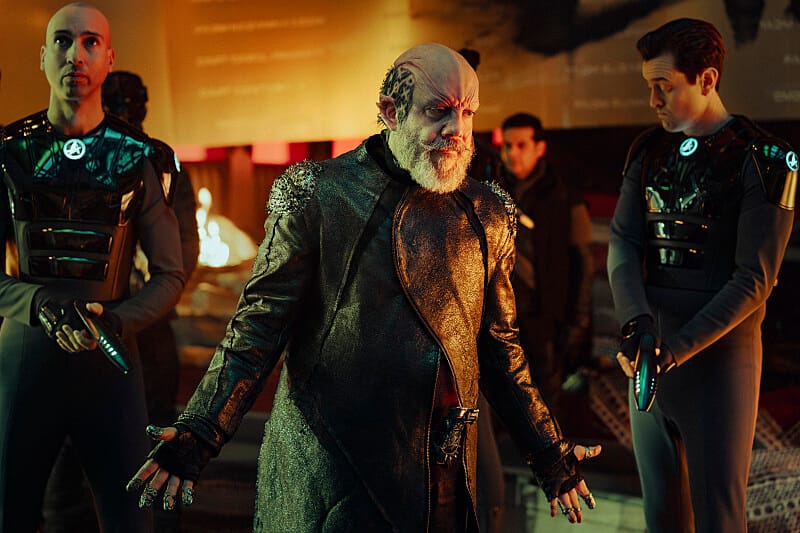
There is something very recognizable in the way he uses spectacle, partial truths, and emotional certainty to create an us-versus-them worldview where nuance immediately looks like weakness. He does not want accountability. He wants a verdict. He wants people to stop imagining repair because destruction is easier to rally around.
But what he cannot do is imagine a future.
That is the emptiness at the center of him.
He can weaponize pain, but he cannot heal it. He can manipulate hurt, but he cannot build from it. He can make people angry and afraid, but he cannot offer them anything beyond more fracture.
And I think that is where this finale really becomes Star Trek.
Because “Rubincon” is not asking us to pretend the Federation is blameless. It is not offering a cheap defense of institutions. It is asking something much harder than that.
Whether a future built on cooperation, equity, and shared responsibility is still worth believing in when the systems tied to those ideals have caused real harm.
What I like is that the episode answers that without making the answer easy.
It is not a shiny yes.
It is a bruised yes. A complicated yes. A yes that comes from people who know betrayal intimately and still choose not to let betrayal become the whole story.
That is why the collective nature of the ending matters so much.
The resolution is not one person swooping in and being the answer. It is everybody. The cadets. The crew. Reno. The Doctor. Ake. Caleb. Anisha.
People with different histories, different wounds, and plenty of reasons to distrust one another still choosing to move in the same direction.
That means something.
Especially in an episode where Braka is trying to sell division as the only honest response to pain. “Rubincon” answers that by showing collaboration not as something easy or idealized, but as something necessary.
Something chosen.
I loved that.
I also loved that for all the scale of what is happening, the episode still makes room for character. Reno still gets to be Reno, thank goodness, and that dry, chaotic, hyper-competent energy is such a gift in an episode this heavy. The cadets feel more grounded here too, more like we are finally seeing the edges of who they are becoming.
Not just students.
Future officers.
Future leaders.
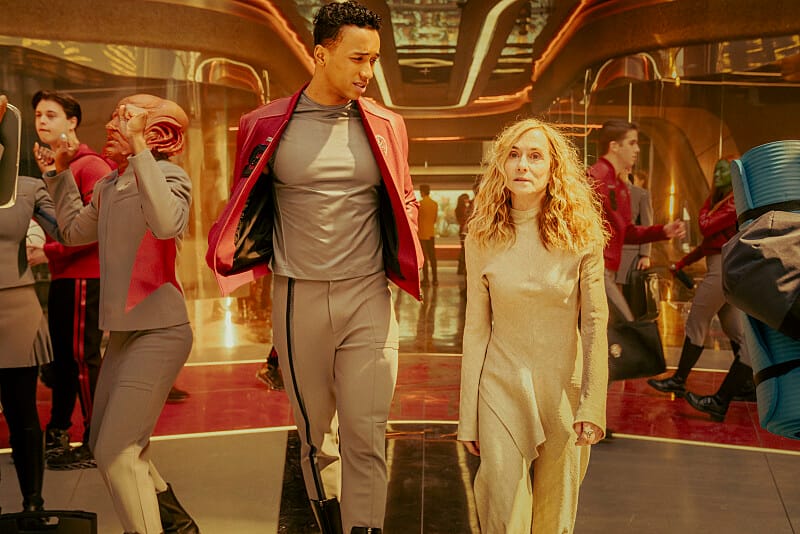
And then there is Caleb, which is where all of this really lands for me.
Caleb’s ending is not satisfying just because he helps save the day.
It is satisfying because he finally stops living like running is the only way to protect himself.
That is the shift.
At the beginning of the season, Caleb felt like someone who was always at a distance from his own life. Guarded. In motion. Never fully settled. Even when he connected with people, part of him still felt ready to bolt.
By the end of “Rubincon,” that is not the whole story anymore.
He chooses Starfleet.
He chooses his friends.
He chooses his future.
And what makes that emotional instead of simple is that he does not have to do it by turning away from his mother. He does not have to choose one home by denying the other.
When he tells Anisha that Starfleet is his home, but so is she, that is the entire season resolving in one line.
He is finally allowing both parts of himself to exist.
That is why the final cadet log works so well.
It is not just a nice ending note. It is a choice. It is Caleb stepping into himself in a way he has not been able to before. Not because everything is fixed. Not because the hurt is gone.
But because he is no longer letting that hurt define the whole horizon of what his life can be.
And that is why I keep coming back to hope with this episode.
Not because “Rubincon” is soft. It is not.
Not because it ignores damage. It absolutely does not.
But because it understands that hope means the most after betrayal, after fear, after every reason not to trust.
Hope matters after pain.
The future is not meaningful because it is guaranteed.
It is meaningful because people choose it anyway.
They choose it while knowing the cost. They choose it while carrying history. They choose it while standing in the wreckage of what did not live up to its promise and deciding the promise still matters enough to keep trying.
That is what Caleb does.
That is what Ake is trying to do.
And that is even what Anisha, in her own way, is pulled back into by the end. Not a neat forgiveness. Not sudden trust. But a willingness to remain in the room and stay present to the possibility that this story is not over yet.
That is why this finale worked for me as much as it did.
It is about healing, but not the kind that erases anything. It is about hope, but not the easy kind. It is about choosing a future together even when you know how fragile that future really is.
That feels deeply Star Trek to me.
And by the end of “Rubincon,” what stayed with me was not just that they saved the Federation.
It was that Caleb chose to stay.