Coming Home to Voyager

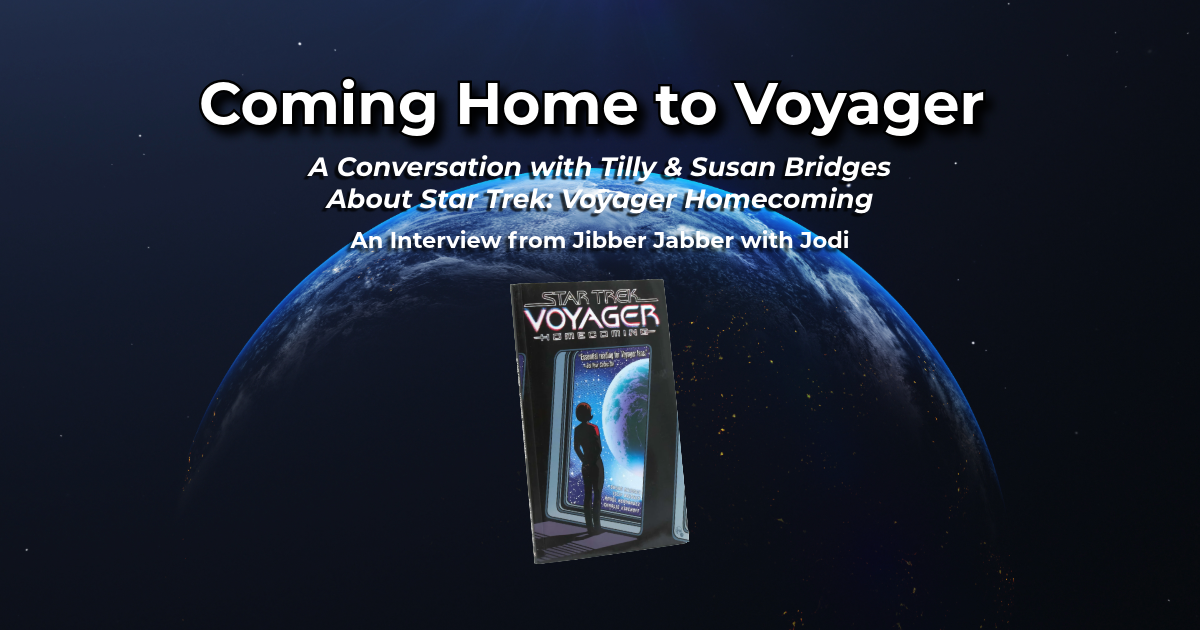
A Conversation with Tilly & Susan Bridges About Star Trek: Voyager Homecoming
There are some endings that feel like endings, and then there are endings that leave you sitting there thinking, “Wait. That’s it? But what happened next?”
For Star Trek: Voyager fans, “Endgame” gave us the moment we had been waiting seven seasons to see. Voyager made it home. After seven years in the Delta Quadrant, Earth was finally there.
And then the screen went dark.
For twenty-five years, fans have imagined what came after that final shot. The reunions. The adjustments. The questions these characters would face once the destination they had spent years fighting toward was finally within reach.
Enter Tilly and Susan Bridges.
In Star Trek: Voyager Homecoming, they step into that space and continue the journey, but they do something more interesting than simply give us an extended epilogue. They tell a new Voyager story. One that understands the characters we remember, the relationships that grew over seven seasons, and the complicated idea of what “home” might mean after everything this crew experienced together.
After reading Homecoming, I wanted to know more. Because as much as I enjoyed returning to these characters, I was just as curious about the two writers who had been trusted to continue their journey.
So, naturally, I had questions. Thankfully, Tilly and Susan agreed to answer them.
Here is my conversation with Tilly and Susan Bridges about Star Trek: Voyager Homecoming.
JJWJ questions appear in bold. Tilly and Susan’s responses appear in italics.
Picking Up Where Voyager Left Off
For readers who may be discovering Star Trek: Voyager Homecoming for the first time, how would you describe the story and what you wanted this continuation of Voyager to feel like?
Homecoming is a grand sci-fi adventure that, we hope, provides a sense of closure and catharsis to Voyager fans who might’ve felt they didn’t quite get that when the show ended. But it’s also a story about self-discovery, about regret over past mistakes, about “the other” and about what happens when we dehumanize those who are different from us.
At its core it’s a story that asks “what is this crew, and indeed all of Starfleet and the Federation, really about?”
And like all the best Star Trek, it asks the reader to see the parallels between this story and the world we live in. And it, hopefully, gives some guidance on the path forward that we should all be trying to build.
Voyager spent seven seasons trying to get home, and “Endgame” left us with that final image of the ship approaching Earth. When you learned you were going to continue the story from essentially that moment, what went through your minds?
Oh, it was terror! Total terror. We’re huge Trekkies and so getting to tell this specific story was legitimately an honor for us, but there was so much pressure. People who watched the original run of the show have been imagining what happened after that final shot, and what the crew reunions with their loved ones on Earth would have been like. There’s no way we could live up to each individual’s head-canon about how those went.
Fans have imagined what happened after that final shot for twenty-five years. How did you approach honoring those expectations while still giving yourselves the freedom to tell your own story?
We decided to just do as right as we could by these characters that we love, and we hoped it could measure up to all those heavy expectations.
You can’t write what you think people want to see, because then you’re not writing from the heart (and everyone wants to see something different anyway). The first audience for any writer is yourself, because if you don’t love the story you’re telling and if your whole heart isn’t in it, it shows. The audience picks up on it.
So we told the story we wanted to tell, and the story we wanted to see as fans ourselves, and stay as true to the show itself, in terms of tone and themes, as we could. In the end that’s all any writer can do—serve your characters and tell your story, and hope it finds the people it’ll connect with.
Rather than simply giving us an extended epilogue, Homecoming quickly becomes a new Voyager adventure. How did you decide what kind of story could both continue the emotional journey of the television series and feel substantial enough to stand on its own?
A large part of that was actually the requirements from IDW and Paramount. We couldn’t have done five issues of hugs and reunions even if we wanted to, because that wouldn’t sell books.
It’s not as nakedly capitalistic as it sounds. Through Heather Antos’ time at the helm of IDW’s Star Trek books, she’s worked really hard to make those comics accessible to everyone. And that’s amazing and to be commended.
They are absolutely books for Star Trek fans, but they’re also books for fans of sci-fi, and also for fans of just really good stories and comics.
With Homecoming, the challenge of that felt really daunting, because this is a story that directly follows a finale, of a show readers may have not even seen, and that is directly tied into many things that happened on the show. But we tried really hard to make the entire thing accessible, so that people who just loved sci-fi and had never seen Voyager, or had maybe even never seen Star Trek, could still follow it and join the ride.
We’ve had multiple people who never saw Voyager, and who were mostly unfamiliar with Trek, read it and tell us they loved it. And that it made them want to go watch the show! That’s the biggest compliment, because it means we did our job.
But sadly, five issues of hugs was never going to be able to do that. We fought for as many pages for reunions as we could possibly get, but this had to be a story that also stood on its own, too.
As for the story we chose, it’s the one that best fit the themes from the show we wanted to explore.
Telling the Story of Homecoming
Of all the stories you could have told after Voyager’s return, what made this particular adventure the one you wanted to explore in Homecoming?
The very apt parallels to the world we’re living in are what jumped out at us, once Species 8472 was agreed upon by all parties as the antagonist of the story.
Going back and rewatching the episodes they appeared in, to refresh our memories and take notes… the pieces were all already there. We just picked them up and filled in the rest of the puzzle.
Homecoming reaches back into Voyager’s history while also pushing the crew into an entirely new situation. Without venturing too far into spoilers, what excited you most about the central conflict you chose for this story?
Outside of it being the story we wanted to tell thematically, getting to add to the mythos and culture of Species 8472 was really delightful. There was very little actually revealed about them on the show, which gave us room to explore what their culture and society is like.
We tried to make them very alien to us, but also similar to some of what we know, in unexpected ways. Those ways tied right into the themes of the story, and got to the heart of what the Federation stands for, and what Starfleet means to Janeway.
It also let us put Janeway in the hot seat for some of the tough decisions (some might even say mistakes) she made in her efforts to get her crew home, and let her wrestle with that. She’s a compassionate and caring leader, so realizing her actions were received in ways she didn’t anticipate would weigh on her.
And getting to start Seven along the path to where we see here in the Picard show was also really exciting.
When you are writing characters as beloved and well established as Janeway, Seven, the Doctor, B’Elanna, Tuvok, Chakotay, Tom and Harry, how do you make them immediately recognizable while still allowing them room to grow?
This was one of the easiest parts for us, at least in terms of recognizability. We’ve seen all 900+ hours of Trek many times, so the character voices came so naturally. We got to spend over a hundred of those hours with Voyager’s crew, time and time again, and the characters were so well-drawn on the show that they just live rent-free in our heads.
It was a little surprising how easily their voices came to us, to be honest! But it just felt natural from page one.
Allowing them room to grow is difficult in a shared universe like Star Trek is, especially when there are already multiple stories with these characters out there that take place after this point in their lives. You can’t push them too far or it won’t line up with what we know about them five or ten years after this, but you also don’t want them to feel stagnant and unchanging.
But we just approached it like they were real people, and real people change in increments over time, as they move through their lives and are affected by their experiences. So we let them have as many of those moments as we could.
Was there one Voyager character whose voice came especially naturally to you, and was there another who took a little more work to get exactly right?
The Doctor was by far the easiest, because he’s so verbose. Every time he talks on the show it’s almost like he says twice as many words as everyone else, and it was a delight to just let him go on and on. Unfortunately dialogue in comics takes up real estate on the page, and covers up art, so we had to cut his lines back again and again to make them fit.
And that made The Doctor also the one who was toughest to get right. When you can’t let him go on for as long as he would on television, but you still want his shorter lines to feel like authentic Doctor lines… that got difficult at times! Because he loves to use a lot of words!
You had twenty-five years of later Star Trek continuity available to you, including knowing where some of these characters eventually end up. How did that knowledge influence the choices you made about their journeys in Homecoming?
Mostly it just gave us future goal posts that we knew the characters would hit, so we had to figure out how much of that we could push them toward. But we also did try to set things up and show some of the connective tissue between where the Voyager crew ends in this story, and where we see them pop up later on in the timeline.
Voyager left behind story threads, relationships and character questions that fans have continued discussing for decades. How did you decide which of those deserved attention in Homecoming and which were better left for another story or for the audience to imagine?
There’s no way any story could address them all. Every television show that runs for over 100 episodes is bound to have those; it’s just the nature of things.
We just picked up the ones that we were most intrigued by, or that tied in best with what we wanted to do. A lot of this project was about finding the right Voyager and Trek bits that worked best with the story we wanted to tell.
So it was pretty easy to leave out the ones that just didn’t fit here.
Whatever happened to Janeway’s and Paris’s Warp 10 salamander babies? Maybe we’re better off not knowing.
We often think of home as a place, but Voyager complicates that because these characters built a home with one another while trying to return to another one. After writing Homecoming, what do you think “home” ultimately means to this crew?
To us, their “home” is each other. Or was, for seven years. But now they have another home, with all their loved ones back in the Alpha Quadrant. We didn’t have much room in this series to explore how each of them feels about those two worlds colliding, but that’d be a really fun thing to explore.
Behind the Story
The two of you write as a team. What does that collaboration actually look like when you are building a Star Trek story together? Are there spirited Bridges family debates happening behind the scenes?
Sometimes! Though almost never about Trek, we’re pretty aligned there. We’ve been writing together, if not as a team, for longer than we’ve been married, so it’s all part and parcel of the same thing for us. Respect, love, and communication makes both the relationship and the writing partnership work.
But we do sometimes argue about which lines to cut or keep!
When you disagree about what a Voyager character would say or do, has there ever been a moment when one of you pulled out an episode, scene or piece of canon as evidence and essentially said, “See? I told you so”?
Nope! We’ve never actually disagreed about that, we both know them far too well.
Comics require the words and artwork to tell the story together. What was it like seeing Ángel Hernández take moments that existed in your scripts, including moments Voyager fans have waited decades to see, and make them real on the page? Was there a panel or sequence that particularly surprised or delighted you?
Oh it was just delightful. Seeing art come in for comics you wrote is always the greatest thing, and it was extra wonderful here when you’re getting to see these characters you’ve loved for so long… in new stories! That you wrote for them!
All of the reunion pages really touched us, and we loved how really alien Angel made all the Species 8472 ships and the Aberraton look.
And also the sequence of Seven, with Miral in a sling, moving through the dark and empty Voyager, trying to repair it while also trying to comfort both Miral and the ailing Tuvok… that whole sequence is so great, and it’s made doubly so by Charlie Kirchoff’s coloring. It feels so cold, and lonely, and a little haunting. And it fits the mood so so well.
You have now had the unusual opportunity to add another chapter to a Star Trek story that fans have carried with them for twenty-five years. When a longtime Voyager fan reaches the final page of Homecoming and closes the book, what do you hope they are feeling ?
Closure and catharsis. And love, but not for us or the book. though that’d be nice. But we hope you’re feeling the love the characters are feeling right then, that was the goal. It’s all love.
One More Before We Beam Out
One of the things I found myself thinking after reading Homecoming was, “If Tilly and Susan Bridges are writing it, I’m going to read it.” So, when readers see your names on a cover, what kind of story do you hope they have come to expect?
Awww. :) Our queer trans YA romcom “Just Another Summer” is out now from Maverick, and “Princesses of the DC Universe” releases next March!
We think what you can expect from our projects is, thematically, what you can expect from Star Trek. It’s foundational upon us both as people, and as writers. You’ll find people celebrating their differences, coming together to work toward a common goal, acceptance and compassion and, yeah, love. You’ll find people fighting to make a better world, and no matter how dark the story may be, there’s always hope. Our stuff is anti-cynical.
And, usually, has a lot of action and humor and sometimes even a sex joke (it was B’Elanna’s fault!).
One Last Transmission
For readers who want to keep up with both of you and whatever you are creating next, where are the best places to follow your work, learn more about your projects, and find out what is coming next from Tilly and Susan Bridges?
The best way is via our social media handles:
Bluesky
@tillybridges.bsky.social
@susanlbridges.bsky.social
Instagram
@heckyeahtillybridges
@susanlbridges
Our writing website has our full list of credits and links to all of our work, and is at https://birdguest.com
And we have a twice-monthly free newsletter about everything we’re up to across every medium we work in, which you can find at http://birdguestbroadcast.com
Thank you for asking us to be part of this, Jodi!
A huge thank you to Tilly and Susan Bridges for taking the time to answer my questions and for giving us another chance to spend time with the crew of Voyager.
Star Trek: Voyager: Homecoming is a story about returning to characters we thought we had left behind, while discovering there was still more of their journey to tell. And after this conversation, I’m even more certain of something I thought when I finished reading it.
If Tilly and Susan Bridges are writing it, I’ll be reading it. 🖖
Read Star Trek: Voyager Homecoming
The collected edition of Star Trek: Voyager Homecoming by Tilly and Susan Bridges, with art by Ángel Hernández, is available now.
As a Bookshop affiliate, I earn from qualifying purchases.
Remember…
✨Be Kind. Do More Good. We Got This.
💫Until next time, lovelies, keep jibber kid jabbering about the stories and things that move you.