The B Major Problem
Standing on a chair with a saxophone taught me that sometimes the ability is already there. What needs to change is the perspective standing in its way.

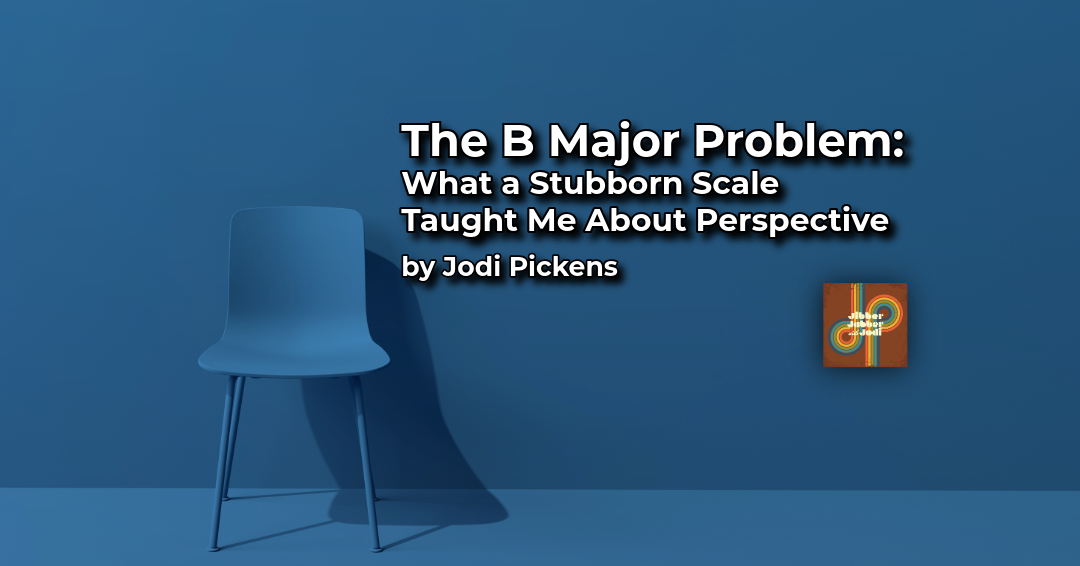
I once learned an important life lesson while standing on a chair holding a saxophone and trying not to fall to my death in front of my college professor.
I studied music in college, which means I spent an unreasonable amount of time practicing scales while surviving almost entirely on caffeine and determination.
Most of them were fine.
But B Major?
Absolutely not.
I do not inherently struggle with sharps. My fingers knew what they were supposed to do. My brain understood the theory. But something about that specific scale broke the connection between my mind and my saxophone every single time I played it.
It became The Scale That Could Not Be Trusted.
My saxophone professor kept pushing me to master it at a tempo that felt deeply disrespectful to both humanity and physics. Week after week I stumbled through it while he sat there with the calm patience of a man who had clearly watched students lose their minds before.
Then one day during a lesson, he looked at me and said:
"Stand on the chair."
When you are a music major, you are exhausted enough at all times that your first response becomes:
"Sure. Why not. Maybe this is jazz."
So I stood on the chair.
Then he said:
"Play the B Major scale."
I sighed. Deeply. Historically.
But I lifted the horn anyway.
And because my brain was suddenly more focused on "please do not fall off this chair" than overthinking the scale, something strange happened.
I played it.
Not perfectly. But without hesitation.
Then my professor turned on the metronome connected to the speakers and blasted the absolutely unhinged tempo he had been trying to get me to play for weeks.
"Again," he said.
So I steadied myself, took a breath, and played.
And suddenly my hands flew across the horn.
Every note landed. Every movement locked into time. No hesitation. No panic.
Like magic.
My professor smiled, turned off the metronome, and told me to step down from the chair.
Then he said something I have carried with me ever since:
"Sometimes you have to change your perspective to do what you already know."
I have thought about that sentence more times than I can count, and the older I get, the more I realize it had almost nothing to do with music. That idea lodged itself somewhere deep, because it turns out perspective is not really a music problem. It is a human one.
Most of us are not trapped by lack of ability nearly as often as we are trapped by the angle from which we are viewing ourselves and everyone else.
Because we do this constantly.
We decide our perspective is the perspective. We build entire identities around assumptions and then forget they were assumptions in the first place.
The brain loves a shortcut. Unfortunately, the brain also loves a bias. And once we repeat a perspective long enough, it starts to feel like objective truth.
Repetition is powerful that way. We absorb messaging constantly from family, media, communities, algorithms, fear, hope, and the thousand little things shaping us every day. And eventually repetition starts masquerading as truth.
Because most people are not intentionally trying to misunderstand each other. They are operating from completely different experiences, fears, histories, and realities. And it is genuinely hard to step outside your own perspective. It requires curiosity, questions, listening, research, and a willingness to imagine realities different from your own. Most importantly, it requires accepting that your experience is not universal.
And that is where people often lose perspective entirely.
Because if someone else experiences the world differently, then maybe our viewpoint is not the complete picture. Maybe our assumptions are unfinished. Human beings do not love that feeling. We want certainty. We want clarity. We want the comfort of a clean, confident answer, even when the reality underneath it tastes like somebody filtered regret through a hiking boot.
But perspective is rarely neat.
It is shaped by culture, history, personality, privilege, geography, trauma, opportunity, survival, and all the invisible experiences that make people who they are. Two people can walk through the exact same moment and come away carrying entirely different truths about it.
And sometimes the hardest perspective to change is the one we hold about ourselves.
We carry old versions of ourselves long after they stop being accurate. A bad experience, one failure, one cruel comment, and suddenly we build entire identities around limitations that may never have been permanent in the first place. We decide we are too awkward, too late, too broken, too much, and eventually we stop testing whether any of it was ever true at all.
That is what I realized sitting in that music studio.
I already knew the B Major scale.
My fingers knew it. My brain knew it. The ability was already there.
What I lacked was a perspective that allowed me to access it.
And I think that happens to a lot of us. We cling to perspective, perspective shapes assumptions, assumptions shape behavior, and behavior reinforces perspective until we can no longer tell where the loop began. We mistake repetition for truth and call it knowing ourselves.
But every once in a while, life hands you a metaphorical chair.
Something shifts your viewpoint just enough to interrupt the pattern. Sometimes it is grief. Sometimes it is art. Sometimes it is travel. Sometimes it is listening instead of preparing your next argument. And sometimes it is standing in a music studio realizing the thing you thought you could not do was something you already knew how to do all along.
Maybe growth is not always becoming someone new. Maybe sometimes it is simply seeing familiar things from a different angle.
Standing on the chair does not guarantee anything. The scale might still fall apart. The old story might creep back in. But the chair is still worth climbing, because the view from up there just might change everything.
Remember…
✨Be Kind. Do More Good. We Got This.
💫Until next time, lovelies, keep jibber jabbering about the stories and things that move you.