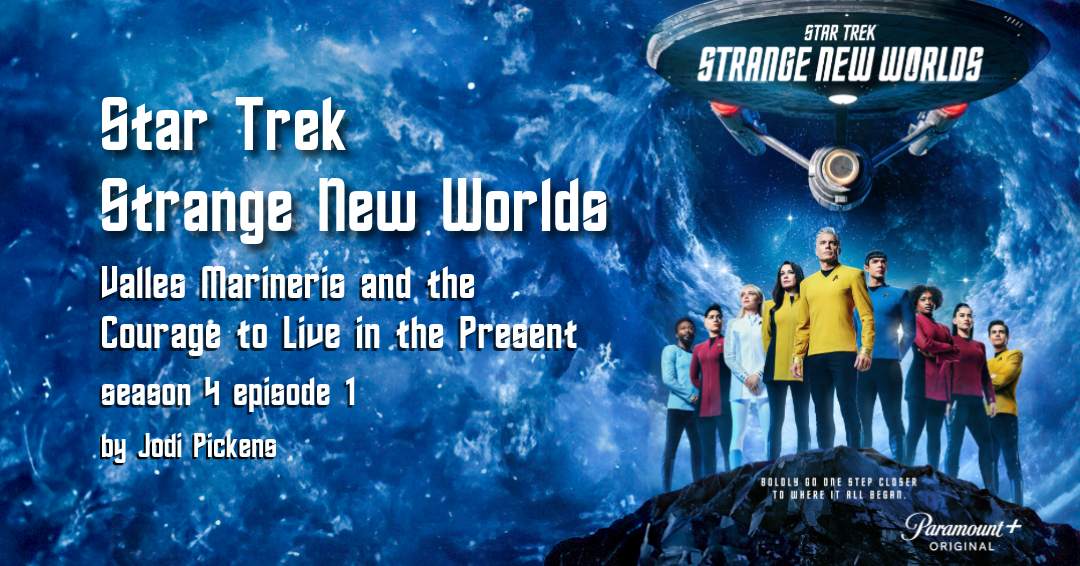
Valles Marineris and the Courage to Live in the Present
Ancient Mars, time travel, dinosaurs, and an uncertain future give Christopher Pike a difficult challenge: remaining fully present in the life he has now.

One of my favorite things about Star Trek is that it has never believed wonder and wisdom are mutually exclusive.
It has always understood that sometimes the biggest ideas arrive wrapped inside the most unexpected stories. A courtroom drama becomes a conversation about prejudice. A holodeck adventure becomes an examination of addiction. A journey across the stars quietly asks what it means to forgive, to hope, or to become a better version of ourselves.
Then, every once in a while, Star Trek reminds us that it can still surprise us.
On paper, the Season Four premiere of Star Trek Strange New Worlds sounds almost impossible to describe with a straight face. Frontier adventure. Ancient Mars. First contact. Time travel. Dinosaurs. An existential meditation on leadership and living in the present.
Somehow, "Valles Marineris" doesn't simply hold those ideas together.
It makes them feel inevitable.
That confidence has become one of Strange New Worlds' defining strengths. The series refuses to believe spectacle and substance exist at opposite ends of the storytelling spectrum. Instead, it embraces the idea that breathtaking adventure and deeply personal character work can strengthen one another.
This premiere may feature some of the most ambitious visuals the series has attempted, but the spectacle is never the destination.
The people are.
Even before the story begins, the redesigned opening titles quietly announce the season's intentions. The Enterprise is still our guide, but the emphasis has shifted toward discovery itself. Strange worlds, impossible landscapes, unfamiliar skies, and the sheer joy of exploration take center stage. It is a subtle evolution, but an effective one. The opening sequence feels less interested in showing us where the Enterprise is going than reminding us why we fell in love with exploration in the first place.
That same sense of confidence extends to the crew.
One of the quiet joys of reaching a fourth season is watching relationships settle into something that feels authentic. The bridge crew no longer feels like a collection of officers serving aboard the same ship. They feel like people who genuinely enjoy sharing the journey.
Scotty's increasingly playful frustration with Ortegas' flying style is already becoming one of my favorite running jokes. Every engineering adjustment feels less like a disagreement and more like two exceptionally talented people learning each other's language. Across the ship, Uhura eagerly prepares to mentor a young Vulcan cadet, only to discover that leadership sometimes begins with patience instead of expertise.
Even the smaller exchanges between Spock and La'an reinforce how naturally these relationships continue to evolve. Nothing feels forced. Nothing feels manufactured. These are simply people who have lived and served together long enough that conversation flows as comfortably as breathing.
That sense of familiarity gives the episode an emotional foundation that allows everything else, even the extraordinary, to feel believable.
Because beneath the prehistoric landscapes, temporal paradoxes, and breathtaking visual effects lies a surprisingly intimate story about Christopher Pike.
Ever since learning the details of his own future, Pike has carried a burden that quietly follows him into every mission. Admiral April's offer of promotion initially sounds like a career milestone, but it quickly becomes something much more personal. It asks whether someone who already knows where their story leads can ever truly focus on the chapter they are living now.
Rebecca Romijn once again reminds us why Number One has become one of the finest first officers in modern Star Trek. She understands Pike well enough to recognize what even he struggles to admit. Sixteen consecutive missions have become more than dedication to duty. Constant motion has become a way of avoiding stillness. If the Enterprise never slows down, perhaps neither do the thoughts waiting for him.
Anson Mount continues to make Pike one of the franchise's most compelling captains because he never mistakes compassion for weakness. He leads with curiosity. He listens before he speaks. He believes understanding is almost always worth pursuing, even when the outcome is uncertain.
That optimism finds its greatest challenge in Captain Cassel.
One of Star Trek's oldest traditions is that its most memorable adversaries rarely see themselves as villains, and Captain Cassel continues that tradition beautifully. She is not driven by conquest. She is driven by survival. Every difficult choice she makes grows from generations of fear, loss, and responsibility. She is trying to preserve a future for her people using the only methods history has taught her will work.
That distinction matters.
It transforms the conflict from good versus evil into something far more interesting.
Hope versus fear.
What fascinated me most was how closely Cassel mirrors Pike. Both captains carry the weight of history. Both believe they are protecting the people under their command. Both are willing to shoulder impossible decisions if it means those people have a tomorrow.
The difference lies in what they still believe is possible.
Pike never stops searching for another conversation.
Cassel has reached a point where conversation itself feels like a luxury her people can no longer afford.
Few conflicts feel more relevant than that.
Ancient Mars becomes one of the episode's most inspired pieces of world-building. Long before becoming the silent red planet we know today, it is imagined as a thriving civilization carrying its own triumphs, failures, and scars. Valles Marineris itself becomes more than a spectacular geological feature. It becomes a reminder that worlds, much like people, are shaped by the histories they survive.
Chris Fisher's direction gives these ideas room to breathe. The sweeping frontier landscapes evoke the adventurous spirit that has always lived within Star Trek's DNA. The scale of ancient Mars feels appropriately epic without overwhelming the story. The interstellar squall is visually stunning, while the quieter scenes aboard the Enterprise allow conversations to linger exactly as long as they need to. Even the episode's prehistoric sequences understand that awe comes as much from restraint as spectacle.
And yes...
There are dinosaurs.
The fact that Star Trek finally gives us dinosaurs and somehow makes them serve the story instead of becoming the story is an achievement all by itself. Somewhere, I have to believe every child who ever parked a toy Enterprise beside a plastic Tyrannosaurus Rex is feeling wonderfully vindicated.
La'an's unforgettable encounter with one particularly determined dinosaur will undoubtedly become one of the premiere's most talked-about moments. Yet even here, the spectacle quietly serves character. Her growing awareness of how her genetic enhancements continue to shape her life hints at emotional questions that feel likely to echo throughout the season ahead.
That is perhaps the episode's greatest accomplishment.
Wonder isn't presented as something separate from character.
Wonder becomes another way of understanding character.
By the time the credits rolled, I found myself thinking less about temporal mechanics than about one quiet conversation near the episode's conclusion. M'Benga gently reminds Pike that he has spent so much of his life thinking about yesterday and tomorrow that perhaps it is finally time to spend a little more time living today.
Simple advice.
Exceptionally difficult to follow.
It is also where "Valles Marineris" reaches beyond science fiction.
Most of us have never captained a starship. Few of us will find ourselves caught inside an interstellar anomaly or standing face to face with a dinosaur.
But nearly all of us know what it feels like to replay yesterday or worry about tomorrow until today quietly slips past unnoticed.
Perhaps that is what this premiere is really exploring.
Not time travel.
Not extinct worlds.
Not ancient civilizations.
The courage to remain present when the past still hurts and the future still feels uncertain.
As the final images fade, the Enterprise leaves behind ancient skies, impossible landscapes, extinct giants, and a chapter of history no one will ever know happened.
Yet those aren't the images that stayed with me.
The image that lingered was Christopher Pike choosing, if only for a little while, to stop carrying tomorrow long enough to fully inhabit today.
The Enterprise has always flown toward horizons it could not yet see.
Maybe that has always been the point.
The future has never belonged to the people who already know all the answers.
It belongs to the ones who keep choosing hope.
Who keep choosing curiosity.
Who keep choosing to explore anyway.
More than sixty years later, that still feels like one of Star Trek's most extraordinary ideas.